


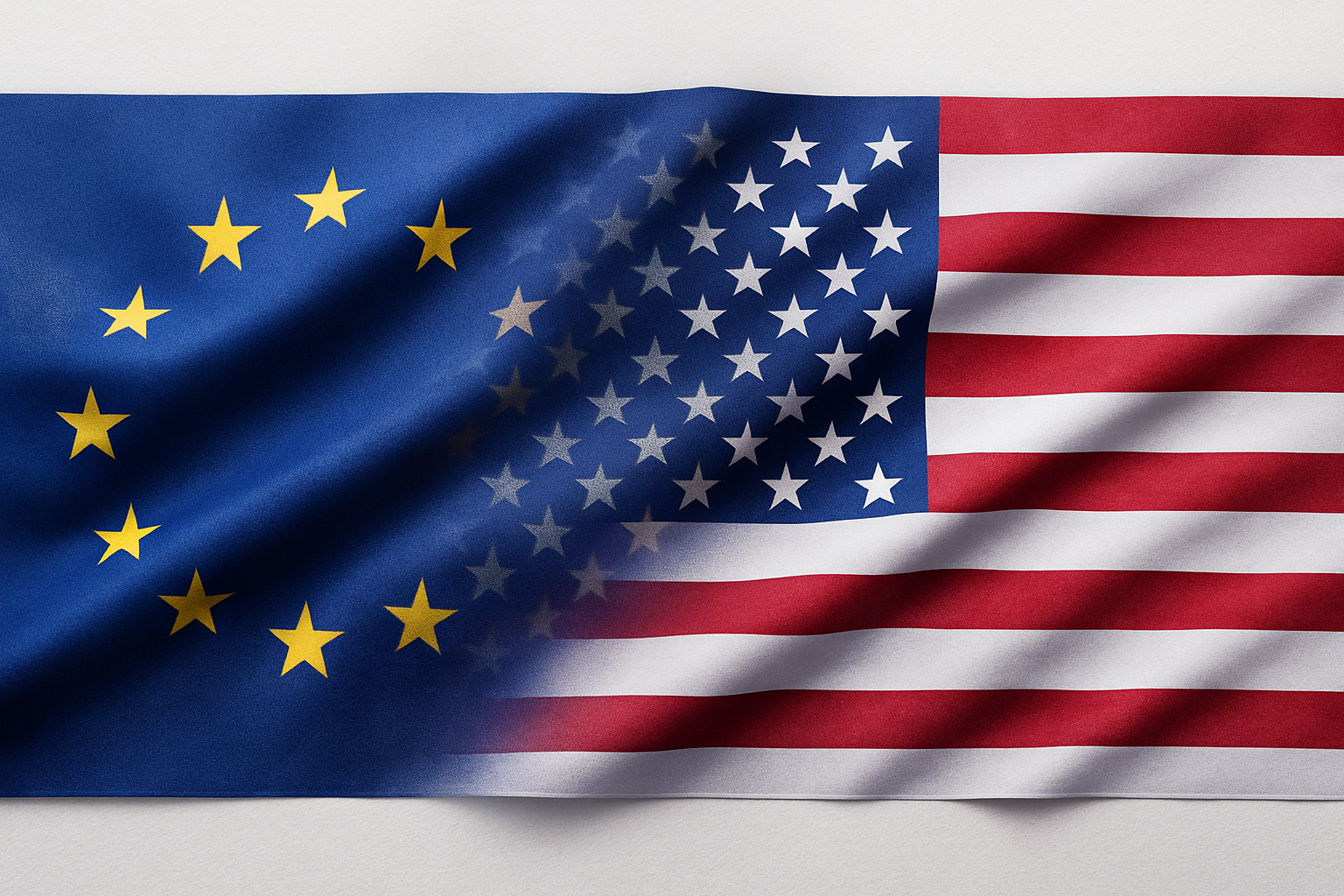
The level of subordination revealed by the agreement between Ursula von der Leyen and Donald Trump has sparked awareness of the European Union’s economic, technological, and political impasse vis-à-vis the United States. This latest transgression by the European Commission President spells an existential crisis for the EU.
The unilateral imposition of US tariffs on European production has caught the public’s attention. In reality, their relatively moderate overall level of 15% is the result of much more substantial concessions made by the European Commission. The EU is committing itself to further increasing its dependence on a range of issues. In order to save the precarious industrial status quo of ultra-exporting industries, particularly in Germany, it is compromising its technological future. Europe is relinquishing any ambition for autonomy in the digital, defense, and energy sectors, in line with the latest NATO summit. Amid the threat of trade chaos, Donald Trump is thus succeeding in imposing not only a new paradigm of unilateral tariffs, but also a much broader logic of economic—and geopolitical—domination over the most aligned countries.
Many EU politicians are expressing their embarrassment at the revelation to the general public of the stalemate in which the EU finds itself. Calls for countermeasures against the US digital sector overlook the stage and real extent of Europe’s capitulation. In exchange for tariffs that are half the threatened 30%, the Commission has effectively given Donald Trump assurances that it will abandon any meaningful policy of technological competition.
Given Germany’s trade surplus with the US, a genuine policy of rebalancing through tariffs or investment would have been legitimate. European leaders should have accepted the principle and technical means of such trade rebalancing, while refusing to compromise on the idea of widespread servitude that would bind future generations. A level-headed approach would have resulted in low tariffs without any additional concessions on technological, military, and energy autonomy. By focusing exclusively on the immediate interests of ultra-exporting industries and on the United States’ most excessive demands, the unrealistic prospect of 30% tariffs in the long term has led Ursula von der Leyen to undermine the EU’s technological potential.
The European Union’s current state of paralysis is deeper than this humiliating trade agreement would suggest. It concerns its governance, extreme bureaucratization, submission to interest groups, and the regurgitation of generic ideologies imported from American culture war by all political factions, from the far right to the far left to the center. The United States is gradually recovering from its industrial meltdown, despite its educational and cultural crisis, by mobilizing its historical strengths. This ability to bounce back relies in particular on the financial resources offered to creative and scientific minds. Conversely, Europe is falling into the habit of copying the most detrimental aspects of US governance and mass culture, without the qualities of a system that gives itself the scientific means to achieve strength.
Faced with industrial decline, the United States is beginning to reindustrialize, thanks in particular to low energy costs. Conversely, the Commission is exporting the chaos of German energy policy to countries that could still benefit from a rational energy infrastructure, and is now promising massive imports of American LNG at prohibitive prices.
While the weakness of the European position had been blatant for many months, representatives of US organizations in Brussels, such as the website Politico Europe, defended the Commission’s position with surprising tenacity, even praising its strength and unity. These sham negotiations have in effect served to seal Europe’s defeat in the face of US corporate interests. Looking beyond Donald Trump’s peculiar style and manner, US international policy tends to be largely bipartisan. The Biden administration’s Inflation Reduction Act was already a sweeping protectionist policy aimed at reindustrializing the US. The European governments’ lack of familiarity with European and global realities paved the way for the von der Leyen Commission’s vacuum, combining submission on the international stage with authoritarianism at home.
More than just a tool for trade rebalancing, Trump sees trade barriers as a form of sanction. It was in light of the escalation in recent months with China, which stood up to him, that he focused on the countries most closely aligned with the US, in a disastrous geopolitical context. This has been particularly apparent in relation to Gaza, where the EU has refused to exert any influence, taking US intimidation to the letter. The limits of economic measures have been demonstrated in the case of a country as large and resource-rich as Russia. Conversely, in the case of Israel, the EU had obvious and immediate levers to put an end to a policy of annihilation in its neighborhood, if it possessed any desire for autonomy and historical awareness. Much more than a simple question of strategy in international negotiations, Europe’s political meltdown points to a crisis of civilization.
This piece was originally published by the French Institute for International and Strategic Affairs (IRIS).