
Category: Markets

  • AI Financial Exuberance as a Shield Against Reality

    AI Financial Exuberance as a Shield Against Reality

    Op-Ed for Les Echos, Friday, June 5, 2026. The text below is a more detailed version of the article published in the print edition of the newspaper.

    The general rebound led by AI and semiconductor stocks, since the onset of de-escalation in the Middle East, is not enough to dispel concerns about the current investment cycle. On the contrary, this exuberance raises questions about its sustainability, against the backdrop of a race among LLM providers to go public.

    The already massive and growing weight of the sector in stock indices fuels a self-reinforcing dynamic, driven by passive investments: the more the sector grows, the more it attracts waves of capital, which in turn drive further growth—until a shock finally disrupts this mechanism.

    From this perspective, markets have quickly dismissed material risks—such as energy shortages or supply chain pressures for essential semiconductor inputs—as temporary. This reaction is not merely diplomatic optimism. For three years, the financing model has relied on the stratospheric expansion of LLMs, while downplaying questions about their business models, the consequences of pricing adjustments in the era of agentic AI, or the intrinsic limitations of these models in terms of reliability.

    The strong performance of cloud and semiconductor companies, combined with abundant liquidity and the dominance of a handful of firms, has reinforced the notion that demand for generative AI infrastructure will remain indefinitely robust.

    Circular Capital Flows and Technological Concentration

    This dynamic stems in part from the increasingly circular structure of financing. In 2026, projections for investments by Nvidia, Alphabet, Apple, Microsoft, and Amazon in “hyperscale” infrastructure range between $600 and $725 billion. The interconnections within this ecosystem are particularly tight. Nvidia occupies a central position as both the dominant supplier of GPUs and a key investor, reinforcing a loop in which investments, demand for computing capacity, and production capabilities are mutually dependent.

    Microsoft has invested $13 billion in OpenAI, whose computing costs rely heavily on Azure—further boosting Microsoft’s cloud revenue and its ability to sustain its investments. Google has poured several billion dollars into Anthropic, which has simultaneously committed to massive cloud infrastructure contracts, split between Google and Amazon. Amazon itself has invested around $8 billion in Anthropic, which then developed subsidized access for developers through the cloud infrastructure of these same companies.

    However, usage-based pricing models (per token) introduce uncertainty about whether this growth can translate into sustainable revenue, particularly if mechanisms of “subsidization” or indirect support were to wane. These mechanisms sustain growth expectations but blur the line between independent demand and self-perpetuating capital flows. A significant portion of the sector’s apparent strength rests on a small number of companies that simultaneously finance the infrastructure, provide the computing power, and support the applications consuming that power.

    The rise of passive investing further amplifies this phenomenon. As major AI-related companies see their valuations climb, their weight in major indices automatically increases, attracting more financial inflows and intensifying market concentration. The “Magnificent Seven” now account for between 30% and 45% of the S&P 500’s market capitalization, depending on the period, while Nvidia’s market cap has surpassed $5 trillion.

    Material Constraints and Financial Fragility

    At the same time, the material foundations of this expansion are becoming increasingly critical. Cutting-edge AI depends on massive growth in electricity consumption, semiconductor manufacturing capacity, cooling systems, and data centers. Semiconductor production itself relies on complex industrial supply chains involving LNG, helium, specialty gases, copper, and stable electrical power.

    Helium exemplifies this dependency. Qatar is one of the world’s leading exporters, and any disruption to maritime routes in the Gulf could quickly impact semiconductor manufacturers in East Asia. In Taiwan, several industrial groups have already expressed concerns about the security of LNG and helium supplies.

    Moreover, the island sits at the heart of the U.S.-China diplomatic chessboard, with Trump’s approach amounting to a refusal to engage on the issue. Meanwhile, China has embraced the U.S. strategy of restricting semiconductor exports and is betting on building its own autonomy—centered around Huawei—which, in the long run, could challenge the dominance of American giants and their financial constructs.

    Additionally, the rapid obsolescence of infrastructure adds another layer of fragility. Data centers built around current GPUs could lose a significant portion of their competitiveness for advanced computing workloads in as little as 18 to 36 months, even if they remain usable for inference or secondary applications. Yet, accounting depreciation periods typically span three to five years, potentially obscuring underutilized infrastructure and delaying visibility into long-term financial obligations.

    This is not about questioning the AI revolution itself, but how financial markets treat LLMs’ growth as limitless—underestimating physical, financial, industrial, and geopolitical constraints… as well as the opportunities of alternative models. Large language models fit naturally into the current financial architecture because they deploy efficiently through cloud infrastructure and (partial) subscription-based business models. In contrast, physical AI—particularly in robotics—operates under a different logic. It depends more on real-world deployment and longer development cycles, which align less neatly with current financing mechanisms.

    This dynamic echoes Minsky’s financial instability hypothesis, which posits that long periods of stability gradually encourage increasing risk-taking. The limits of financial and industrial resilience may soon force a rude awakening, perhaps triggered by profit-taking after a wave of IPOs.


  • AI Financial Mechanics under Real-World Constraints

    AI Financial Mechanics under Real-World Constraints

    This piece is based on my research, The Global AI Race amid Asset Bubble Dynamics, which I will present on Friday, 15 May 2026, at King’s College London. .

    Deescalation in the Iran war has unleashed a market rebound led by AI and semiconductor stocks. Its strength in the face of major challenges actually raises questions about the sustainability of the broader boom. Physical disruptions persist, from energy shortages to critical materials, and the de-escalation remains fragile, with Donald Trump unwilling to resume hostilities yet unable to consolidate a lasting and realistic agreement. Long periods of strong performance, abundant liquidity and dominance by a few large firms have trained markets to treat disruptions as temporary and manageable.

    Despite AI’s many promises, circular funding and loss-making business models underpin the financial dynamic. The rise of passive investing supports this mechanism. Large tech firms receive a major share of these investments and in turn keep fueling circular financing within the sector, helping maintain their own earnings. This echoes various theoretical frameworks on asset bubbles.

    The global bet on the scalability of LLMs to reach human-level intelligence fits perfectly within this financial logic. Meanwhile, essential developments in physical AI, particularly for robotics, suggest a different technological path and financial structure.

    The Financial Mechanic and Its Technological Impact

    The rally in AI-related stocks reflects a market downplaying industrial effects from disruptions in the Gulf. Markets quickly returned to the dominant narrative of rising AI investment, continued infrastructure expansion and strong demand for advanced semiconductors. Nvidia, its suppliers, memory manufacturers and cloud infrastructure firms led the rebound. So far, there have been no major visible disruptions to semiconductor production, reinforcing investor positioning in the sector despite geopolitical uncertainty. Investors largely treated the situation as a temporary geopolitical disturbance rather than systemic stress.

    Semiconductor stocks are led by AI infrastructure growth expectations. Strong earnings guidance reinforces the belief that compute demand remains effectively unconstrained. As long as digital giants maintain investment plans and financing conditions remain supportive, markets tend to interpret geopolitical shocks as disturbance rather than turning points. The current rally reflects confidence in AI-driven earnings growth, continued hyperscaler investment and passive flows reinforcing index concentration in a small group of large technology firms. The so-called Magnificent Seven now represent 30–45% of S&P 500 capitalization and Nvidia’s market cap has exceeded $5 trillion.

    Part of this strength reflects the increasingly interconnected structure of AI-related investment. Amazon, Microsoft, Alphabet and Meta are projected to spend well over $600 billion on AI infrastructure in 2026, with some estimates approaching or exceeding $700 billion. Microsoft has invested approximately $13 billion in OpenAI, whose workloads reinforce Azure demand and revenue. Alphabet has invested heavily in Anthropic, with reported financing commitments potentially reaching $40 billion. Anthropic has reportedly agreed to spend roughly $200 billion on Google Cloud infrastructure over five years. Amazon has also expanded its investment in Anthropic beyond the original $8 billion commitment, alongside reported long-term AWS procurement agreements exceeding $100 billion over a decade.

    The prospect of usage-based pricing models (per token) introduce uncertainty over whether the observed expansion in usage will translate into durable willingness to pay once investors “subsidies”, credits, or strategic cross-subsidisation are reduced. This creates a gap between measured demand growth and underlying monetisation capacity.

    Obsolescence add to the risk. Semiconductor progress is rapid enough that data centers built on current GPUs may become less efficient within 1.5–3 years, while remaining useful for inference and secondary applications. Depreciation schedules of 3–5 years stretch asset lifetimes beyond their peak economic usefulness, potentially masking underutilized infrastructure. Off-balance-sheet leasing structures can further delay visibility of long-term obligations.

    Furthermore capital concentration shapes technological choice. Large language models fit the current financial structure well. They scale on GPU infrastructure and align with subscription-based revenue models. Physical AI, particularly robotics, operates differently. It depends on physical systems, long development cycles and data that cannot be easily replicated in cloud environments.

    Theoretical frameworks explain these dynamics. The notion of reflexivity highlights how rising valuations attract further capital. Minsky’s instability hypothesis describes how stability encourages risk-taking. Shiller’s irrational exuberance emphasizes the role of narratives in driving capital flows. The unabated rise of passive investing reinforces these effects through index-linked momentum.

    The US–China chip competition adds complexity. US export controls on H100 and H200 GPUs force China to rely on domestic alternatives, though performance gaps vary by workload as local accelerators improve in certain use cases. State-backed funding reduces political constraints but does not remove inefficiencies. Chinese firms such as Alibaba and Tencent have significantly increased AI and cloud-related spending, while hardware constraints force higher spending for equivalent compute output. The result is a more fragmented semiconductor ecosystem, with duplicated investment.

    Physical Supply Chains and Semiconductor Production

    Financial markets and physical supply systems are not fully aligned. The Strait of Hormuz remains a critical energy and logistics corridor. It also affects flows of industrial inputs that are difficult to substitute quickly. Semiconductor production depends on LNG, helium, specialty gases, copper, cooling systems and stable electricity supply. Several of these inputs remain exposed to maritime risk in the Gulf region, though current data suggest limited constraint at this point.

    Helium illustrates this dependence clearly. Qatar is one of the world’s largest helium exporters and any disruption to transport routes can quickly affect semiconductor manufacturers in East Asia. Industry groups in Taiwan have raised concerns about LNG and helium security. The issue is the gradual reduction of redundancy in already tight supply systems.

    Market pricing assumes that conditions will normalize before supply constraints affect production or expansion. This assumption may prove correct. The semiconductor industry has repeatedly adapted to logistics shocks through inventory management, supplier diversification and government coordination. Markets are not ignoring geopolitical risk entirely. Oil prices, shipping costs and insurance premiums have all reacted. But equity investors—especially in AI-linked sectors—are still assigning relatively low probability to prolonged industrial disruption compared with current earnings momentum and investment trends.

    Physical Constraints, Valuation and Fragility

    The AI investment cycle has created a tight link between financial expectations and physical infrastructure. Unlike earlier software cycles, frontier AI requires continuous expansion in electricity use, data center capacity, semiconductor fabrication and cooling systems. This exposes the sector to physical constraints as well as financial conditions. Transformer shortages, copper constraints and grid delays are already emerging in several regions. Hyperscale expansion increasingly competes with broader industrial and public electricity demand.

    These constraints are only partially reflected in market pricing, which remains focused on growth narratives and future monetization potential. Index composition also plays a structural role. Semiconductor and hyperscaler firms now account for a large share of global equity indices. As their valuations rise, passive investment flows reinforce their dominance, strengthening momentum regardless of changes in underlying risk conditions. Capital concentration therefore becomes self-reinforcing during periods of uncertainty.

    Financial resilience and industrial resilience are no longer moving in lockstep. This does not imply current valuations are irrational or that a correction is imminent. The AI buildout is producing real revenue growth, infrastructure expansion and rising demand for compute. The issue is that markets increasingly extrapolate this trajectory as sustainable or unlimited, while assuming geopolitical and industrial disruptions remain temporary.

    Historically, strong technological cycles often produce similar assumptions. During periods of rapid capital concentration, markets tend to prioritize scale and dominance Fragility tends to appear only when constraints persist longer than expected or when financing tightens alongside operational stress. The current environment contains elements of both outcomes. Semiconductor demand remains strong, but its supporting infrastructure is increasingly exposed to geopolitical concentration. Taiwan remains central to advanced manufacturing. Gulf shipping routes remain important for energy and industrial inputs. Electricity systems are under pressure from AI-driven demand growth. Much of this expansion still depends on sustained capital expenditure and favorable financial conditions.

    The recent market rally may reflect less a resolution of geopolitical risk than the growing dominance of the AI investment framework in global markets. Investors still appear to assume that the importance of AI infrastructure will continue to justify large-scale capital deployment despite visible physical constraints and the lack of a viable business model.

  • The Art of the Non-Deal: Mishandling Negotiations Without Re-escalation

    The Art of the Non-Deal: Mishandling Negotiations Without Re-escalation

    Deescalation in the Iran war happened as the US administration sensed that continuation carried too much economic cost, as a result of the energy crisis. The argument holds more than ever, especially when it come to the threat of re-escalation. This process however did not lead to a phase of structured agreement but rather a halt to the conflict, with ambiguous rules. Markets have interpreted this situation as if it already meant long-term stabilization, assuming a level of general resolution that cannot be easily achieved.

    Donald Trump tried to leverage this situation as if it already contained the outline of a deal, and to accelerate the sequence accordingly. Although the Strait of Hormuz could be reopened with a limited, even implicit understanding, this aim has so far been defeated by the attempt to rush broad negotiations under extreme threats.

    His framing of Iran’s concessions on enriched uranium follows this approach, moving the public narrative ahead of the negotiation itself. He tried to transform deescalation into a political outcome that could be presented as victory to his audience, rather than as an exit from an unsustainable military stalemate. Political obfuscation surrounding a military outcome tends to disrupt any long-term stabilization.

    The nuclear issue does not compress easily, since it requires explicit steps. At the same time, Israel introduces a separate constraint, since its objectives and claims in the region contradict a prolonged deescalation. This too pushes the US side to rush negotiation, not because conditions are ready, but because the balance is unstable.

    Narrative over Negotiation

    Donald Trump has described Iran’s position on its nuclear program, particularly regarding enriched uranium, in terms that had not been agreed by Tehran. As in other negotiations, his tactics consist in attributing to the counterpart concessions that are expected rather than obtained, as if the process could be advanced by anticipating its conclusion publicly.

    This approach reflects an attempt to convert deescalation into a rapid political outcome that can be presented as a success. The objective is less the construction of a detailed and sequenced agreement — which would require time and technical alignment — than the establishment of a perception of movement on Iran’s core positions. The negotiation is thus partly shaped by political signaling of victory rather than convergence.

    This logic is closely linked to a form of brinkmanship, where pressure is assumed to generate linear responses. The underlying assumption is that Iran will adjust its stance whenever the United States modulates escalation or restraint. It leaves open the possibility of operations or coercive actions, particularly as a comprehensive nuclear agreement remains distant and structurally difficult to assemble. The risk is therefore not so much a return to full-scale war, but a cycle of episodic escalation within a still-contained and reversible configuration.

    An Off-ramp Constrained by Its Own Logic

    The underlying constraint remains a preference in Washington to avoid a renewed large-scale confrontation, given its economic and strategic costs. At the same time, the absence of tangible diplomatic results is difficult to acknowledge politically. This produces an intermediate position in which disengagement is pursued while being continuously framed as progress or even victory. This results in a configuration that neither leads to stability or restarting the war, but where fragility comes from the attempt to compress a process that remains inherently slow.

    Israel’s role adds a second structural layer of instability. Its regional objectives, including territorial gains and expanded military control clash with the prospect of a prolonged deescalation phase. The divergence is structural and long-term, as US popular support of Israel quickly erodes. In practice, this has required the US administration to rely on explicit pressure to restrain Israeli moves long enough to preserve a narrow window for accelerated negotiations with Iran. The difficulty is that this sequencing is already under strain.

    Hormuz and the Structure of the Stalemate

    The Strait of Hormuz remains the central variable. A durable normalization would require coordination on passage rules, some form of fees or regulatory mechanism, and a broader ceasefire framework extending beyond the Strait itself, including Lebanon. None of these elements are in place as a result of the excessive focus on a global deal including the nuclear issue.

    The recent sequence highlights a persistent misalignment. The United States has maintained pressure while expecting functional normalization, while Iran has treated the Strait as a lever of negotiation rather. In practice, any sustained reopening requires coordination, even in the absence of a comprehensive agreement.

    External actors further complicate the picture. China, in particular, has been critical of a regime of fees that would alter flow conditions, while offering substantial material support probably more valuable than the toll booth model. This increases pressure on Iran to accept arrangements that preserve access. The equilibrium therefore depends on a balance of constraints and opportunities rather than only on a formal diplomatic settlement.

    At this stage, two broad configurations remain plausible. The first is the emergence of a partial framework, limited in scope but sufficient to organize coordination around the strait and establish minimal normalization conditions. This would allow Iran some economic space while leaving the nuclear issue only partially resolved. The second is a more explicitly frozen conflict, where no agreement is reached but where a managed status quo emerges, including conditional reopening of the Strait and continued tactical coordination between actors.

    For markets, many pricing assumptions remain built on simplified scenario frameworks that understate the institutional fragility of the situation, particularly around energy flows. The current situation should be understood as a reorganization rather than a resolution. Deescalation provides a temporary equilibrium, but it is increasingly exposed to attempts to convert it into a rapid political success without the institutional basis required to sustain it. Though the rationale for deescalation is more present than ever, the gap between political acceleration and structural constraint defines the fragility of the current situation.

  • Energy Markets Will Remain Shaped by Iran’s New Status Quo

    Energy Markets Will Remain Shaped by Iran’s New Status Quo

    Op-ed in Les Echos, 11 April, 2026.

    Iran’s control over the Strait of Hormuz is upending global energy markets. Prices remain under pressure, and geopolitical uncertainties are hindering a return to normalcy. Investors and governments must adapt to this new equilibrium, characterized by structurally higher costs and persistent tensions, according to economist Rémi Bourgeot.

    Iran’s dominance over the Strait of Hormuz, coupled with the emergence of a new transit regime, is poised to have a lasting structural impact on global supply chains and price formation. This new reality is expected to have enduring effects on both markets and the real economy. There is little prospect of energy markets fully reverting to their pre-conflict state, even in the event of de-escalation.

    The conflict has been marked by Donald Trump’s erratic shifts between negotiation overtures and escalation threats, with no viable strategy in sight, underscoring the pressing need for de-escalation. The current ceasefire is diplomatically unstable, with parties failing to agree even on essential aspects such as the halt of Israeli strikes on Lebanon or on the version of Iran’s proposed list of negotiating points. While the prospect of a genuine peace agreement remains distant, the U.S. withdrawal from the Iranian front is rooted in the necessity of extricating itself from a particularly damaging stalemate. It thus seems unlikely that the United States will seek to fully reopen this front.

    Nevertheless, a U.S. disengagement without a concrete agreement paves the way for a new, ambiguous situation. The status of the Strait of Hormuz risks remaining undefined, based on the de facto control Iran exercises. It is therefore crucial to anticipate the dynamics that may prevail in energy markets amid this shifting landscape. Iran’s control over the Strait of Hormuz, coupled with the emergence of a new transit regime, is poised to exert a structural impact on global supply and price formation. This new reality is likely to have lasting effects on both markets and the real economy. There is little prospect of energy markets fully returning to their pre-war state, even in a de-escalation scenario.

    The rest of this piece is available on Les Échos website in French. For similar insights, see my April 1, 2026 article, which already analyzed the implications of a looming de-escalation—with Iran’s de facto control over the management of the Strait of Hormuz: Partial Normalization in Energy Markets After Iran War Deescalation.

  • Iran to Control Reopening of Strait of Hormuz

    Iran to Control Reopening of Strait of Hormuz

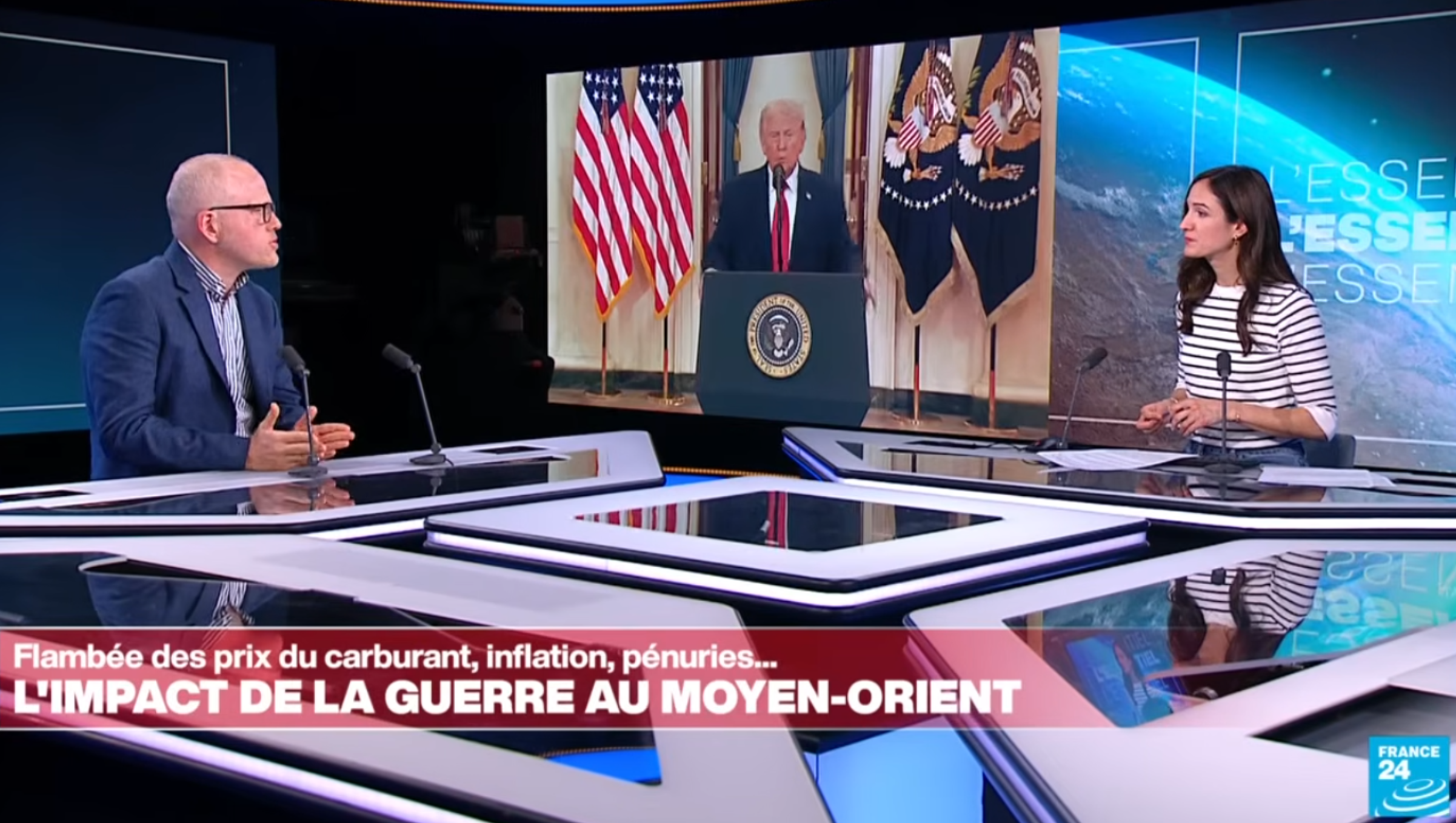
    I was interviewed by France 24 about the energy crisis and the challenges of reopening the Strait of Hormuz amid the military stalemate. English transcript below the video.

    Rémi Bourgeot, you’ve been following this crisis very closely. Is this only the beginning?

    It obviously depends on how the military situation evolves. Donald Trump has been sending mixed signals, and markets have been swinging wildly in response.

    What we are seeing, in any case, is a military quagmire. Some geopolitical experts believe this is only the beginning. There are also signs of panic on the part of the U.S. administration, particularly from Donald Trump, who actually dislikes war. In fact, he prefers theatrical operations, like the one in Venezuela a few weeks ago. This, however, is a genuine quagmire.

    So he is sending signals suggesting he would like to stop, while striking as hard as possible. The Iranians, for their part, largely dominate the situation, but they are also sending signals through these exchanges, notably with Oman, to at least establish some kind of framework that could apply to a partial reopening.

    But what we are heading toward is Iranian control over the Strait of Hormuz. It could be reopened in part, even quite broadly, but likely under Iranian control, given that the United States is not capable of reaching its objectives—assuming there ever were tangible ones.

    This Iranian control over the Strait of Hormuz, over time, implies a different system, a different economic regime, notably involving tolls, of which we have already seen certain outlines, partially implemented. That does not mean this will be the final configuration, but costs will be raised and this transit system will be put in place in a way that serves Iran’s geopolitical interests.

    There have also been behind-the-scenes signals of exchanges between Iran and certain Gulf states—especially Qatar—to avoid strikes. But the situation is extremely tense, particularly with the United Arab Emirates, which has called on the United States to “finish the job,” to escalate, implicitly suggesting the deployment of ground troops. One could imagine Iran penalizing the United Arab Emirates more than other Gulf states.

    And in any case, this reopening cannot be achieved by force, only through negotiations?

    There is no real negotiation. There may have been emails or very indirect contacts, but there are very serious doubts about the reality of Donald Trump’s statements when it comes to negotiations.

    That said, the notion of de-escalation cannot be ruled out. This is not what we are seeing these days, but Trump is extremely uncomfortable with the situation and understands that he needs to withdraw. His political position is collapsing. There are very serious doubts about his personal condition and about the political system surrounding him. He is dismissing generals around him in order to hear what he wants to hear, to avoid bad news.

    What we are seeing is a genuine regime crisis developing in the United States, with much deeper roots. There is also an industrial side to this crisis, as the manufacturing base is unable to sustain what would be a long war.

    On the question of ground troops, this is perhaps the most revealing signal: there has been no such announcement. There has been no announcement either of an end to the war or of a withdrawal. Yet sending ground troops would mark the entry into a long war, with even more severe uncertainties—something that would be almost suicidal on Donald Trump’s part.

    Today, we are in an in-between situation, with a desire to get out of this quagmire, but Trump wants to be able to claim some form of victory and avoid humiliation. That humiliation is there in any case.

    To return to the very concrete consequences of this political and military deadlock, there has been much discussion in recent weeks about measures taken by countries to ration fuel, cut taxes, and provide subsidies. France, for the time being, is refusing to do any of this. Is that relevant?

    When it comes to acting on prices, taxes are often short-term measures. They can have positive effects. But the real situation we are facing is a form of shortage that is now emerging. This is about very concrete, material realities: ships that were supposed to arrive are not arriving. A shortage is taking hold, already very severe in Asia.

    It is worth recalling that Europe is much less dependent on the Gulf for its energy supply than many Asian countries. The various sources of supply—Norway, North Africa, the United States for LNG, and partly the Gulf—show that this dependence exists but remains limited. Some countries have larger reserves; this is the case for China, which also has greater autonomy, while still being largely dependent on the Gulf.

    The reality is therefore material: a shortage is taking shape. It is less pronounced in Europe, but it is already being felt. This is happening in the context of an economic crisis, particularly an industrial one, that was already acute before the start of this war. The issue of energy prices was already critical, with the effects of the war in Ukraine: loss of supply, attempts to reorient away from Russia, but at the cost of creating new dependencies—on the United States or on certain Gulf countries.

    We are thus seeing a form of hyper-globalization of energy networks that is now proving extremely vulnerable.

    On top of the crisis you’re describing, there is also inflation—the general rise in prices, including food prices to come. Should people in France prepare for this?

    Yes, it has a strong inflationary effect. We are not in the same situation as with the war in Ukraine, which came after the pandemic and very expansionary fiscal policies. We are not seeing the same kind of surge, but inflation is clearly rising.

    Above all, inflation is a composite index: behind it lies everyday life, constrained spending that affects certain activities and certain social groups more than others. That is what is particularly problematic, both socially and in terms of political instability.

    For more on the energy crisis and the Strait of Hormuz, read Partial Normalization in Energy Markets After Iran War Deescalation.

    This transcript has been slightly edited for clarity.

  • Partial Normalization in Energy Markets After Iran War Deescalation

    Partial Normalization in Energy Markets After Iran War Deescalation

    Energy markets are unlikely to fully return to prewar standards once a deescalation process starts. The conflict has introduced lasting costs. In particular, Iran’s role in the Strait of Hormuz has become structural to global supply risk and pricing, as a new transit regime can be expected to apply. This new normal should have a lasting effect on financial markets and the real economy.

    This piece is published in partnership with the French Institute for International and Strategic Affairs (IRIS).

    Donald Trump’s statements about the terms of negotiations with Iran have astonished many as they did not seem grounded in real diplomatic channels. Meanwhile, his threats of massive escalation and ground offensives hardly pointed to a realistic strategy, given the enormous political and economic cost, as even the European governments most aligned with the U.S. started to distance themselves. Although confusing, this agitation finally reveals the urgency to find an exit from the quagmire. In practice, deescalation can occur even without full negotiations. It is important to understand what dynamics will be at play in energy markets in light of this trend.

    Tehran has been exerting control over shipping through Hormuz during the conflict, by dramatically restricting or threatening access but also applying charges on commercial ships for transit. Sustained control over the strait would translate into direct economic influence and pricing effects on global energy markets. This can take the form of negotiated transit fees, enhanced monitoring requirements, and arrangements that reflect Tehran’s geopolitical interests.

    Such explicit or implicit arrangements would sustain a structural premium on energy prices. Transit fees could act like reparations, providing revenue to rebuild infrastructure and support the regime, while structurally sustaining a premium on global energy prices. Simultaneously, some sanctions have been effectively relaxed in the sense that Iranian crude continues to flow through the Strait of Hormuz, reflecting U.S. reluctance to further tighten supply and worsen global price shocks.

    Market Price Dynamics and Short‑Term Reactions

    A cessation of hostilities would reduce active risk to tankers allowed passage by Tehran and reassure insurers, lowering the current premium embedded in energy prices. It would quickly see at least a partial reversal of the price spikes, which translated into an overall 60 percent surge. Global equity indices rose and energy futures already fell on various reports of deescalation prospects.

    However, a deescalation process alone does not guarantee an immediate restoration of normal flows or of confidence in the security of transit routes. Reconstruction of damaged infrastructure, clarification of maritime security arrangements, and the re‑establishment of reliable insurance coverage are all prerequisites to a fully functioning transport environment. These processes take time and some degree of international coordination. Risk premia and cost structures in energy markets can therefore be expected to persist above prewar levels.

    The overall disruption to oil markets is unprecedented and price behavior cannot be read solely through short‑term trading patterns, in one way or another. Oil and gas futures curves frequently reflect this complexity. For example, short‑term contracts have exhibited backwardation — where near‑term prices are higher than further delivery dates, indicating that markets expect supply constraints to ease over time even if the near‑term remains tight. However, persistent risk premiums and structural changes in supply can maintain a higher baseline.

    A Lasting Economic Impact

    Meanwhile, prolonged increases in energy prices feed through into inflation. Energy‑related price pressure will persist beyond short‑run market repricing. Persistent inflationary pressure complicates macroeconomic trends, reinforcing second‑round effects such as wage demands and broader price adjustments beyond energy components. In turn, higher inflation expectations and elevated energy costs feed directly into bond yields on government debt, affecting sustainability.

    For energy importers, the implications extend beyond immediate price levels. Disruptions affect contract structures, investment decisions in alternative supply lines and household cost burdens. Europe, while less directly reliant on Gulf than Asia for crude oil and LNG, faces its own challenges in terms of supply and pricing dynamics. With the relegation of nuclear energy production Europe’s strategy has tended to become a process of shifting from one external dependency to another as crises erupt.

    Deescalation reduces acute risk, but structural factors such as Iran’s control over the Strait of Hormuz and the time needed to rebuild confidence and infrastructure mean the market may settle at a new normal contrasting with prewar levels. The interplay between security, infrastructure, inflation dynamics and fiscal stress will shape financial and macroeconomic conditions in ways that a simple cessation of hostilities does not entirely resolve.

    This piece only serves analytical purposes and does not constitute investment advice.

  • Why Gold Loses Its Appeal Amid the Iran War

    Why Gold Loses Its Appeal Amid the Iran War

    I answered questions from journalist Nils Adler on gold’s steadiness despite the Iran quagmire. In addition to quotes on Al Jazeera’s website, here is my broader analysis.

    A geo-economic shock such as the disruption of the Strait of Hormuz would traditionally be seen as driving gold demand higher. However, structural factors have tempered its safe-haven appeal.

    Flight to Liquidity, Volatility, and Market Psychology

    During major crises, financial markets often experience broad stress, with assets across the board under pressure as investors seek liquidity and safety, particularly in the U.S. dollar and Treasuries. Even gold, historically a safe haven, can remain flat or decline when markets favor cash or liquid assets. This pattern has been evident as the Iran war escalated. Gold has stayed relatively stable rather than rallying sharply, despite extreme tensions. Paradoxically, it is the potentially systemic nature of this crisis that limits demand for gold, as other financial mechanisms play out.

    In addition, the Federal Reserve’s stance remains decisive. Rising energy costs and persistent inflation reinforce expectations that interest rates may stay elevated, strengthening the dollar and making interest-bearing assets more attractive than non-yielding gold. This interaction suppresses bullion’s immediate appeal, showing how monetary policy interacts with geopolitical and structural financial risks.

    Also, the gold market is increasingly shaped by speculative trading and heightened volatility, which can spook risk-averse investors. Rapid swings and profit-taking discourage accumulation, undermining gold’s role as a safe-haven asset. Pre-existing multi-year highs amplify this effect, preventing a full-scale flight into bullion. Speculative volatility can defeat gold’s short-term function.

    Meanwhile, apart from bouts of systemic financial risks which can trigger flights to dollar liquidity, the geo-economic landscape will remain shaped by massive fragmentation, which support diversification efforts, including into gold over the longer term.

    Protracted Stalemate, Escalation Risk, and Energy Shocks

    The U.S. is faced with a strategic fiasco, as Donald Trump did not anticipate Iran’s response on gulf states and the strait of Hormuz. While he threatens to keep going up the escalation ladder, even his closest allies refuse to participate in high-risk, potentially suicidal, missions to escort tankers in the strait. The economic and political consequences pressure him to look for an escape strategy,

    However, even in case of deescalation, cessation of hostilities and reopening of the strait, a long-term negotiated peace between US/Israel and Iran is now out of reach for the foreseeable future. The central scenario is a protracted stalemate, which prolongs regional instability and durably threatens the Gulf’s export reliability. The conflict cannot be seen as a mere short-term and limited event. It will have significant consequences on the global economy and the block logic.

    Sanctions and Financial Fragmentation

    The expanding scope of sanctions and the increasing use of trade policy as a tool of geopolitical coercion have contributed to a fragmentation of the global financial system, encouraging state institutions, banks, and multinational corporations to explore alternatives to dollar‑based mechanisms. Where once the dollar served as a relatively uncontested anchor for international trade and reserve holdings, the growing risk of exclusion from dollar clearing and finance has led policymakers in several regions to reassess their reliance on U.S.‑centric systems. The war in Ukraine illustrated how quickly the reliance on traditional financial instruments can shift. The outbreak of hostilities and the flow of sanctions coincided with a sharp rise in the price of gold, as investors and central banks sought perceived safe havens.

    More recently, escalating trade tensions and competitive tariff strategies have prompted renewed diversification, whether through other currencies, gold and other commodities, or the development of regional payment systems. These dynamics suggest a broader reassessment of long‑standing assumptions about dollar dominance and raise questions about how economic policies will evolve in an era of intensifying geopolitical rivalry.

    The Essence of Gold

    Gold’s trajectory depends on the consequences of the Iran conflict, central bank responses, and the structural fragility of global finance. The muted price response to the Iran war confirms that gold does not always skyrocket during crises. Its enduring value lies in being a real, physical store of wealth, reflecting interactions among liquidity, sanctions, dollar dominance, interest rates, speculative volatility, and strategic uncertainty, rather than acting solely as a short-term panic hedge. Even under strong sanctions and geopolitical risk, gold’s primary role is preservation of wealth, not reactive price spikes.

    This piece is published for analytical purposes and does not constitute investment advice.