

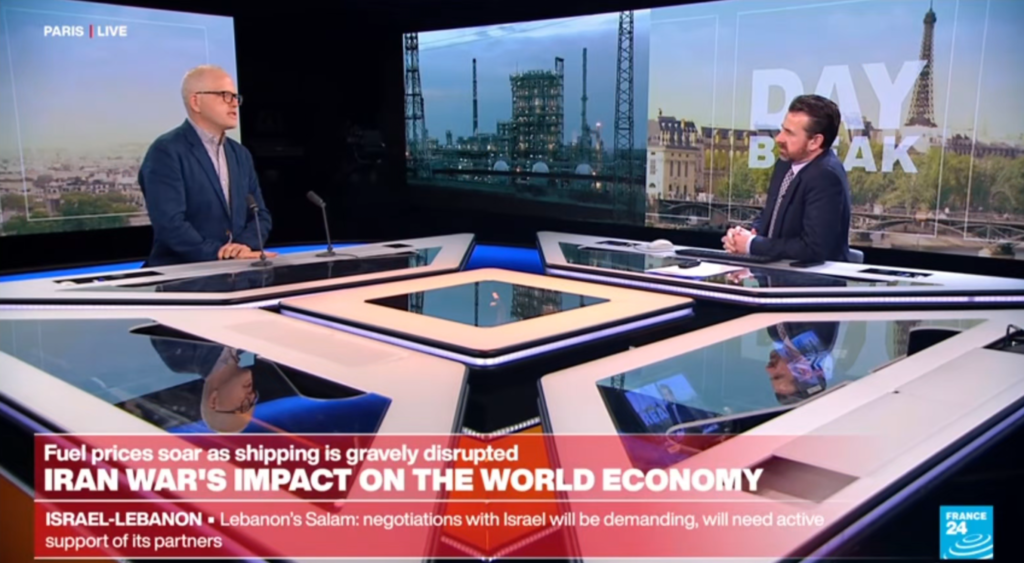
On France 24, I discussed the deep industrial impact of the Iran war and the shift in political bargaining:
– Economic forecasts tend to account poorly for shocks in the physical world, focusing on market price variations and assuming substitution. The main economic damage lies in material shortages and supply chain disruptions, from energy to fertilizers to helium for chips manufacturing…
– Geopolitically, Trump’s grand bargain on uranium enrichment has stalled. With a peace deal a distant prospect, sanctions relief for Iran is off the table as well. More focused steps should now center on the strait: the level of Iranian control, the lifting of the US blockade, and some international coordination.
Full transcript of the interview:
Good morning, Rémi, and thank you very much for being with us. Can I start by asking you what the immediate effects of the Iran war have been economically, beyond the fuel crunch, which of course everyone is very familiar with?
This situation in energy markets isn’t just a story about rising oil and gas prices—it’s really disrupting supply chains all over the world in critical aspects. It’s about energy imports for many countries, especially in Asia, and also in Europe, but to a lesser extent. But it’s affecting some industries very, very heavily through price surges and shortages.
There was little awareness in the beginning that critical components like helium would disrupt supply chains in production, such as semiconductors and chips generally. So it’s really a global crisis sparked by these shortages and by the way production is being disrupted.
It’s not just about economic statistics or making assumptions about how GDP might be affected over a three-month horizon. It’s a much deeper crisis, really affecting supply chains. And that goes beyond the scope of just short-term economic monitoring and forecasting. It’s a real industrial crisis with so many ramifications—also for food production, in terms of fertilizer imports for so many countries.
The Gulf has become so critical, not just beyond energy. Energy is obviously key, but we see all these ramifications, and this is affecting countries and industries across the world in very different ways. For some countries and social groups, this is having really dramatic effects—it can create situations of famine. You can go to such extreme levels.
You mentioned helium there. Qatar exports 40% of the world’s supply, and it’s used in the production of semiconductors and pretty much across tech in general and other sectors. What might the societal repercussions of shortages in this sense mean for the world?
It was somehow reminiscent of what happened during the COVID pandemic. Supply chains were heavily disrupted, and then there was also a boom in demand with fiscal support. So this is really running very deep into supply chains. You see disruptions everywhere.
Some countries have stocks, so the effect is not immediate. It’s just like in energy markets—some countries have had this policy, this strategy of storing a lot of oil. That’s the case with China, which is supposed to be very dependent on the Gulf but is less affected in the short term thanks to this storage policy. So it applies to many countries and industries. But over time, after a few weeks and especially after a few months, you start to see much more concrete effects with these shortages.
It means it’s really affecting production. It’s not just the rise in prices. There’s really a gap in production at the moment. This directly translates into decreased production. It’s not just about price signals or higher costs—it’s really outside the scope of usual everyday economic reasoning. It’s a crisis affecting the material world, not just economic models.
Now, how critical is this for a lasting peace to be reached in this war? We’ve got an extension, an indefinite extension of the ceasefire, but that does not mean the war is over. Is there a big difference between the war continuing for another three to four weeks or the war continuing beyond that? Or is there already sufficient damage that will be felt for months to come?
Well, it’s a critical distinction indeed. The prospect of a lasting peace or a lasting peace agreement, in my view, is still very distant. There’s been so much confusion in the negotiations—or in the talks, I should say—between Iran and the US, with this focus on the American part on the nuclear issue, even attributing statements to the Iranians which were completely unthinkable in their view. So negotiations have really not taken a good path in that respect.
In the end, you have this prolongation of the ceasefire, and it’s indefinite. That’s really what matters in terms of relieving the pressure somehow. I think the talks are going to focus on the Strait of Hormuz and finding some kind of compromise—acknowledging Iran’s control of the Strait with some toll booth model.
China, for example, has been pressuring Iran to take a moderate approach on the issue of fees. But the key focus right now is finding some kind of limited compromise rather than achieving a peace deal. The US doesn’t even have the proper negotiators to achieve any such aim. There’s been so much confusion on the part of the US to impose this kind of counter-blockade of Iranian ports and ships. It’s trying to have leverage on this specific issue of the reopening of the Strait of Hormuz to find some way with Iran.
But the prospect of incorporating all the possible aspects of a deal, including nuclear energy and uranium enrichment, is really very ambitious and a very distant prospect.
Now the UK and France are spearheading talks to open the Strait of Hormuz or to keep it open once the war comes to an end. We’ve often spoken of de-risking with regards to China from the perspective of Western countries, but is this an instance of European countries perhaps de-risking in the face of Washington’s current unpredictability?
Well, I think when it comes to managing the Strait of Hormuz, it’s not so much a strategy towards the US. There will need to be some kind of international arrangement, even if Iran retains control over the Strait and charges fees. That’s why the Iranians were willing to make some arrangements with Oman to have this international dimension to the management of the Strait.
Europe clearly can be part of it. There needs to be some agreement, some arrangement to reopen the Strait, to make traffic happen smoothly, to reassure insurers, and to return to some kind of business as usual. It won’t be like before—it will be a new situation, clearly—but it has to be a predictable one. That’s really the key issue here.
That’s why the Europeans are all playing this part, trying to show this willingness to take part in an international system of cooperation guaranteeing passage—not free passage literally, but to create a kind of new normalcy for passage through the Strait. That’s really what’s essential. It’s not just Iran stopping its threats to ships and the US lifting their counter-blockade. You need to have a real kind of international arrangement for things to resume in some normal way.