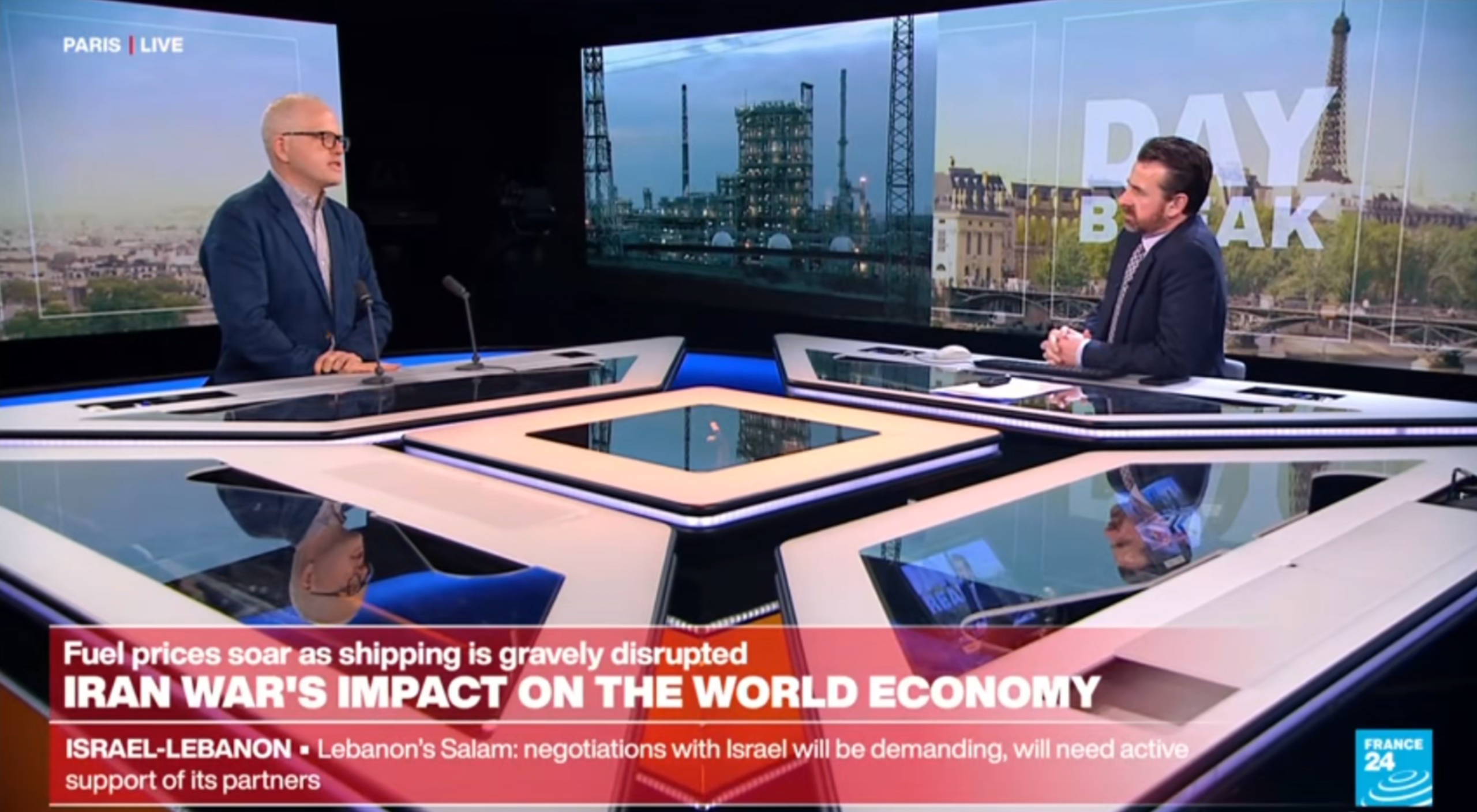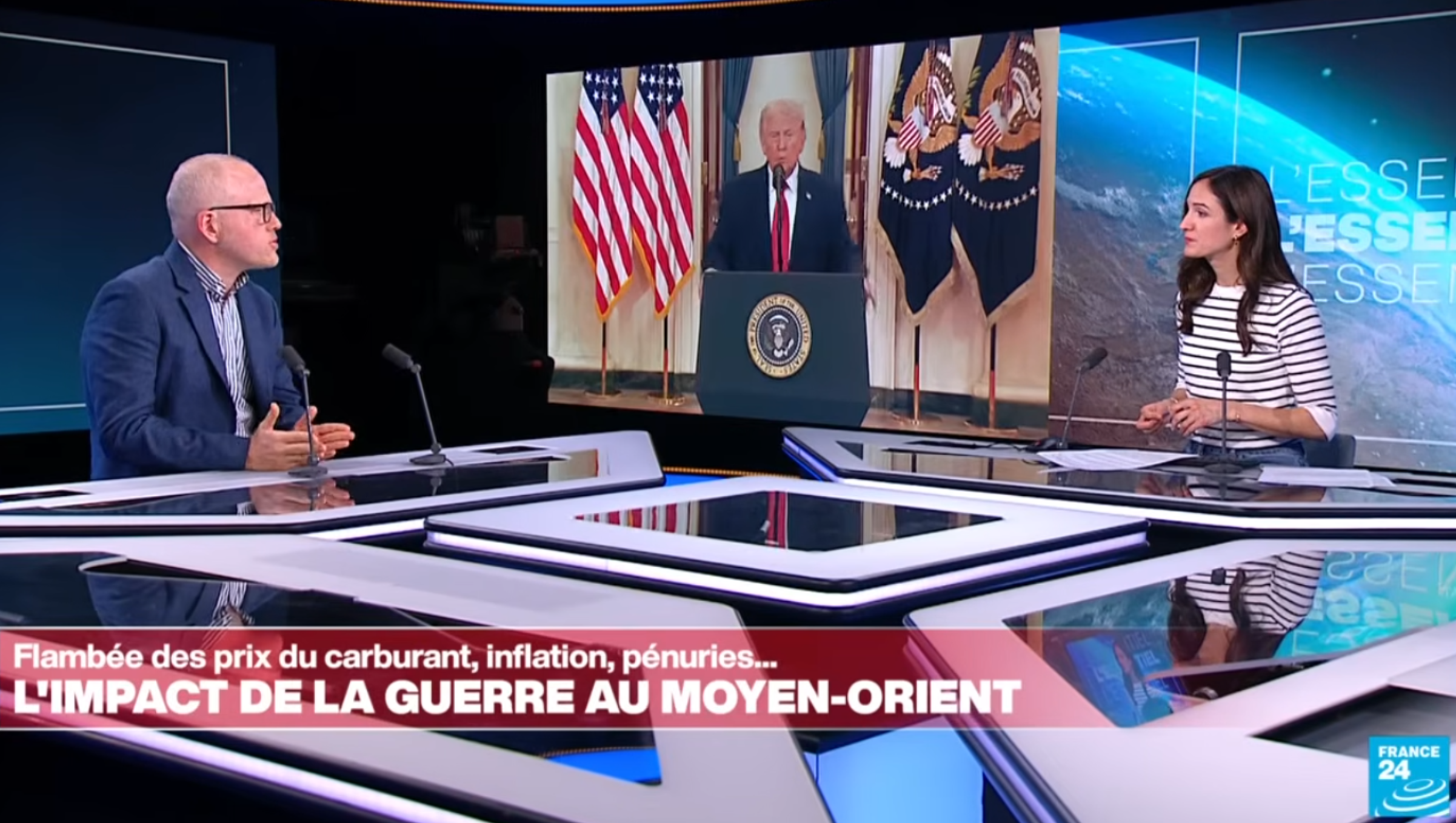


I took part in Radio France Internationale’s Today’s Debate, hosted by Romain Auzouy. Below is a transcription of my contribution to the discussion.
RFI: Rémi Bourgeot, this “Economic D-Day,” in Donald Trump’s words, so this new U.S. strategy toward Iran, which obviously concerns Tehran first and foremost, but also, in order to target Iran more effectively, all countries that would maintain relations with Iran: do you think this could ultimately have more of an impact on the regime in Tehran than the American bombs?
Rémi Bourgeot: That is how Donald Trump presents it to the rest of the people shaping opinion in Washington, and particularly to neoconservative circles. He needs to tell them that he is continuing this drive to crush Iran. Since it has been a huge failure militarily, he claims he is going to continue the war on the economic front. Then, when you look more closely, there is a huge gap between these stated objectives, which are to economically suffocate Iran, and the reality of what the United States can actually do in terms of additional sanctions.
We are talking about secondary sanctions, about threatening Iran’s economic and commercial partners so that they stop trading with Iran as much as possible. So one very important country in this equation is China, which is Iran’s main partner when it comes to hydrocarbon imports, and also when it comes to supplying Iran with all kinds of components, particularly for industrial and military purposes.
For China, it is clear that there is no question of enforcing these secondary sanctions. It has instructed its companies, particularly its banks, not to be intimidated and not to implement these sanctions. In a way, it has already been through this with the trade war, by rejecting certain American threats and threatening to restrict rare-earth exports last year. So on that basis, it is responding very differently than it did a few years ago to the question of enforcing sanctions, and it is rejecting them.
And on that basis, we are seeing a number of countries that are fairly close to Iran commercially following the same path. Even Pakistan has said it will not enforce these sanctions, these threats of secondary sanctions. So that gives you an idea of just how limited the impact actually is. Turkey is in NATO, at the same time it has relations with Iran, but it has absolutely no desire to follow the United States down this road. People say Iraq would be the case, but that also shows how limited the effect is, in a way.
Then, I don’t think it is unreasonable, from Donald Trump’s personal point of view, to go and tell those neoconservative circles I was referring to: “I’m carrying on.” We can see that he is stuck. There is a kind of regime crisis unfolding in Washington. He knows he is in the middle of a fiasco, that going to war with Iran was a huge mistake. He has no military way out, and this can partly be a way of escaping this situation, this military dead end, by pursuing the war more on the economic front.
But beyond that, I don’t think he is particularly interested in the actual effect, which is limited. Obviously, we should remember that Iran is already under very substantial sanctions and is economically strangled in any case. But this idea of targeting all the relationships, all the trade that Iran currently has, particularly with China, remains a very distant prospect.
It is perhaps more of a political act, then, something the United States knows well: the U.S. has been sanctioning Iran virtually since 1979. Doesn’t China’s attitude already show the ineffectiveness of sanctions, which you were talking about? For example, China buys 90% of Iranian oil. So, once China is able to ensure that these sanctions don’t affect it, particularly in Beijing’s case — this is the whole issue with secondary sanctions, which cut off access to the dollar, the essential channel for international transactions — but China uses the yuan through its own financial system that it has built. Does all of this mean that, whatever form they take, sanctions cannot bring about the kind of economic strangulation the United States claims they can?
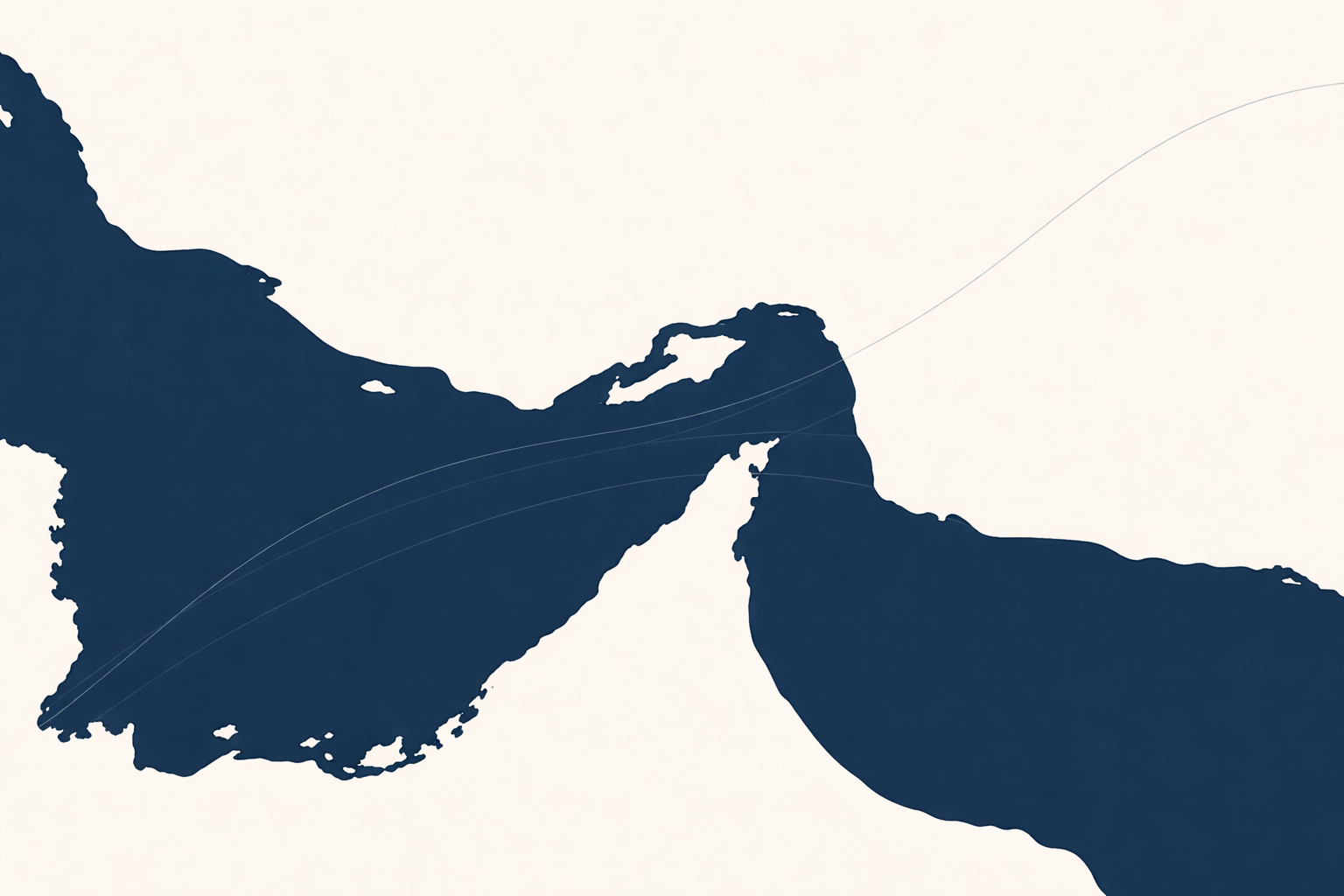
You have the situation linked to the Strait of Hormuz, where exports are nevertheless limited. You have the American counter-blockade, so there is still some traffic taking place, but it remains very limited. Then we can see an architecture adapting to these American threats, and above all to their erratic nature. So you have this architecture becoming more firmly established in terms of payment systems.
But then there are also issues of trust and dependence that remain very significant when it comes to the dollar. But if we take a broader view, we still have this enormous bloc centered around China, with Russia as well, which is a crucial factor when it comes to sanctions.
Now, with the Iranian front, we have a huge bloc that has come together. It is not completely unified. Obviously, each country is defending its own interests, but they interact, they trade, they provide one another with essential things, and above all, they now have formidable industrial capacity. That is what is lacking on the Western side, with this crisis in industrial production, and that is what is on the minds of all decision-makers, particularly Donald Trump.
There is the political message, as you said. It is interesting to bring up China’s attitude toward Russia. China is much more discreet in the Russian conflict than it is when it comes to Iran. Would you say that, ultimately, perhaps we have never had so many states using — or at least, perhaps, economic sanctions have rarely been used so extensively — to threaten states, to distance them, and never to pursue what Michel Duclos was saying? Ultimately, perhaps sanctions have never been circumvented to this extent, as in China’s case, which may be at the very heart of this issue, because China is the country countering the sanctions weapon today?
The idea of sanctions really became significant during what we call the unipolar moment, after the collapse of the Soviet Union, with this overwhelming power of the United States, and with this idea of economic warfare, of shaping the world through interventions in some cases, but also through all kinds of economic measures, particularly sanctions, economic warfare. And since then, a lot has happened.
We have seen the emergence of certain countries, major industrial and technological powers like China, and even countries such as Iran and Russia have also developed their own industrial and technological momentum. They train a higher proportion of engineers than Western countries. That is the direction they are moving in today, and we are seeing a kind of convergence, in fact, taking place.
We see it particularly in terms of military production capacity, where there is a huge problem on the Western side in the various wars being fought in Ukraine or against Iran, or on all sorts of issues. On the other side, we have more of a crisis of overproduction centered on China, and a whole group of countries that are part of this industrial and technological development dynamic, that train huge numbers of engineers and still know how to make use of them.
And so sanctions are, in a way, somewhat anachronistic when it comes to these countries. Sanctions were designed at a time when these countries were much less developed, much less resilient. Since then, they have not only developed considerably in industrial and educational terms, but obviously they have also learned how to circumvent sanctions in all sorts of ways.
For example, Russia, at the beginning of the Ukrainian affair, around 2010–2014, was still at a different stage of development. It was much less interested in industrial issues. The sanctions actually pushed it to make an effort in that direction and really set this dynamic in motion.
So obviously, sanctions do have an effect, but they also encourage countries to be inventive, to find ways around them, through different financial means and different channels, but also by going much further in terms of educational and industrial development.
We said that it obviously impoverishes people. The first group affected by these economic sanctions is the population; they become poorer. Can this turn populations against the regime in question? Could that also be the objective of sanctions?
That is the objective. But in Iran’s case, for example, we can see that the threat is existential. Trump has not hidden that. At the beginning, we were talking about Iranian women football players and I don’t know what, and a few weeks later Trump was talking about annihilating Iranian civilization. So we were no longer really in what you might call a humanitarian discourse.
So in Iran, what we have seen instead is a rallying effect. That is often what happens in the case of massive bombardments, when a nation faces an existential threat.
And today, there has indeed been a change of regime, not in the sense of the neoconservative theories, but the regime has effectively changed, and today we have more of a military dictatorship, with these figures coming from the Islamic Revolutionary Guard Corps, these veterans of the Iran-Iraq War, who are much less religiously conservative, who have also relaxed the enforcement of religious rules considerably, particularly when it comes to wearing the veil. We see many women who are not veiled in Iran’s major cities, particularly in Tehran.
So what we have seen is more of a form of partial unification, obviously, but a form of rallying by the population in the face of the existential threat posed by the United States and Israel. That is more on the military attack side.
Then sanctions do play a role, of course, but without this whole context over the past twenty years, one could imagine that an emerging middle class, much more visible in Iran, with precisely these ideals of political change, might have led the regime to adapt much more, or even to genuinely change.
This whole highly antagonistic context with the United States has probably tended instead to keep the regime in place.
The regime in place, yes, because one could also have imagined that, in this desire to impoverish the population, there was this idea that, effectively, sanctions make that situation even worse.