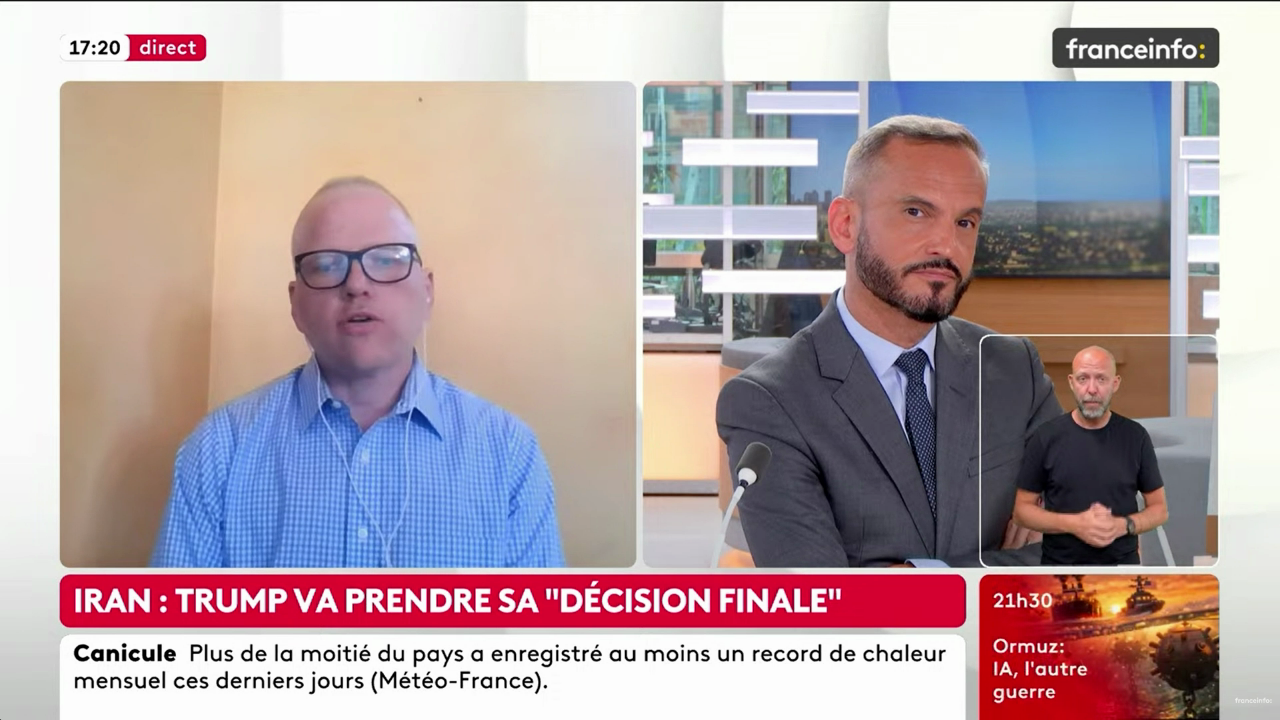
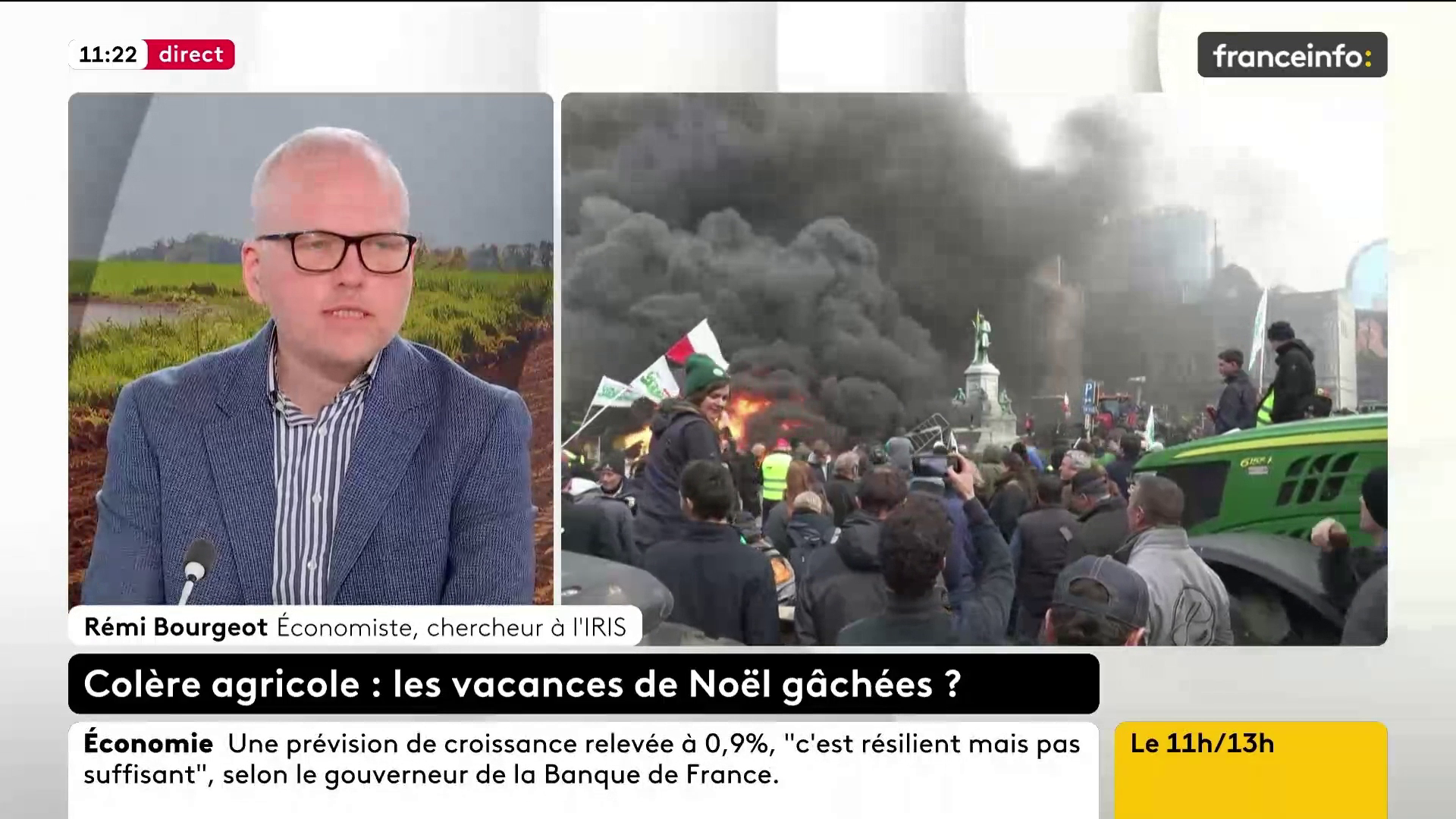
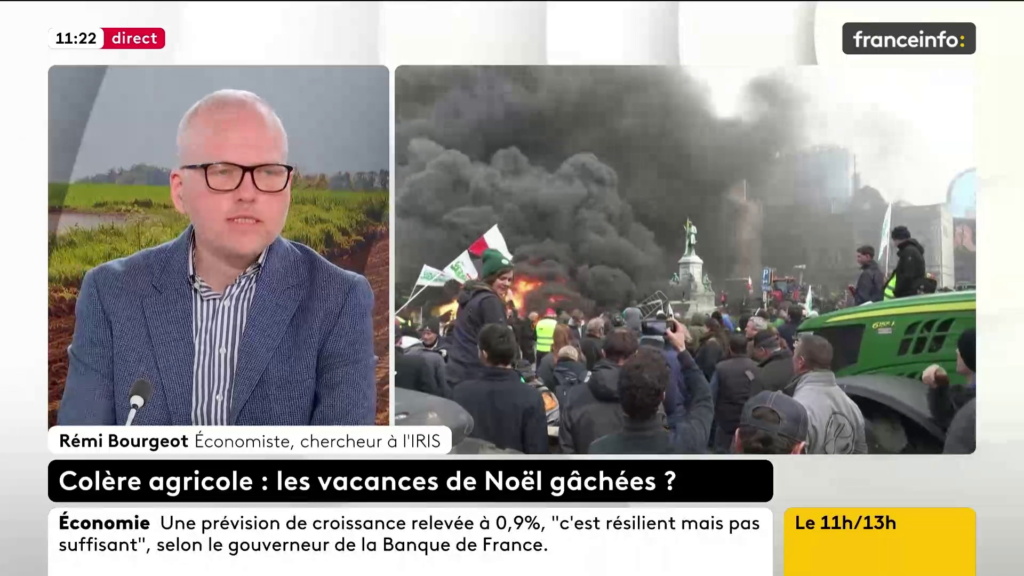
English transcript of my interview on France Info TV – 29 May 2026.
Hello, Rémi Bourgeot.At the heart of this issue, as always, is money—the economy. In Donald Trump’s decisions, just minutes ago, we were told the U.S. president wanted to take his time before possibly announcing his decision on the Iran deal. And now, we see things accelerating. Do you see an economic dimension here?
Rémi Bourgeot: Absolutely,this is the primary source of pressure on Donald Trump, stemming from the global economy and the U.S. economy. So he’s under this urgency.
But today, he’s also facing internal divisions. Personally, he quickly realized the disaster that the U.S.-Israeli campaign against Iran had become, especially since he’d been promised it would only last a few days.
On the American side, he’s dealing with tensions from parts of the Republican Party, particularly the neoconservatives, who oppose any diplomatically realistic agreement. And then there’s the pressure from Israel, which—at least from Benjamin Netanyahu’s perspective—has no interest in reaching a deal with Iran, let alone one with regional repercussions, especially regarding the war against Lebanon. So the situation remains highly uncertain.
For the Americans, the core issue is still nuclear. Yet we also see the weight of Iran’s position and the immense military challenges—on top of the economic difficulties the U.S. faces—having to concede to Iran’s main demand: delaying a nuclear agreement. Let’s not forget that under Obama, such negotiations took years. Today, the discussion is about Iran committing not to develop nuclear weapons—but that’s already the case. The negotiations focus on civilian nuclear programs and enrichment levels to prevent Iran from being in a technical position to develop military nuclear capabilities.
We’re seeing a situation of extreme difficulty for the United States. Trump has recognized the deadlock he’s in, but he’s facing massive opposition and pressure, with all this back-and-forth and incredible uncertainty. And the negotiation process itself is quite surprising: he’s being asked to approve something that, in theory, he himself is supposed to negotiate—because the negotiators have a very limited mandate.
So the parties are indeed trying to agree on reopening the Strait of Hormuz, which was fully open before this conflict. But beyond this partial agreement, tensions remain extremely high with the U.S., which is struggling to acknowledge this strategic defeat.
Rémi Bourgeot, you’re still with us. Are we talking about war, potential solutions to the conflict, or not? And are we mainly discussing nuclear and oil issues?
Yes, I think it’s fair to say that even if an agreement is reached, it would be a very partial one. In reality, the situation would look much more like a frozen conflict than a peace deal. The goal is to reopen the Strait of Hormuz and, for now, set aside the nuclear issue for a potential future agreement—because such negotiations take a very long time.
What’s happening right now is that Donald Trump feels the need to include the word “nuclear” in his announcement. But in reality, this isn’t a genuine concession, since Iran isn’t developing—and did not intend to develop—a military nuclear program. That wasn’t the issue.
As for enrichment, even for civilian or experimental purposes, concessions were already on the table. For Iran, the key is maintaining the ability to enrich uranium. So we’re seeing the situation unfold as it has over the past three months.
This is a strategic debacle for the United States and for Israel as well. Trump is facing immense difficulty in reaching an agreement, even though he’s been trying for two months to extricate himself from this situation.
The most significant concession from Iran seems to be over control of the Strait of Hormuz. Even if they adjust access or transit conditions, or reopen the strait in coordination with the Americans, they’ve demonstrated what some have called their own “nuclear weapon”: the ability to control the strait, albeit with very limited means compared to, say, their ballistic missile program.
So we’re looking at a situation that leans toward a frozen conflict, with the prospect of a nuclear deal coming later. The positive side is that there’s a shared will to reopen the Strait of Hormuz and make mutual concessions. But there’s still a major roadblock on the U.S. side, which Trump must overcome to realistically achieve any kind of breakthrough.
Thank you, Rémi Bourgeot, for your analysis.
This automatic transcript has been edited for the sake of clarity.
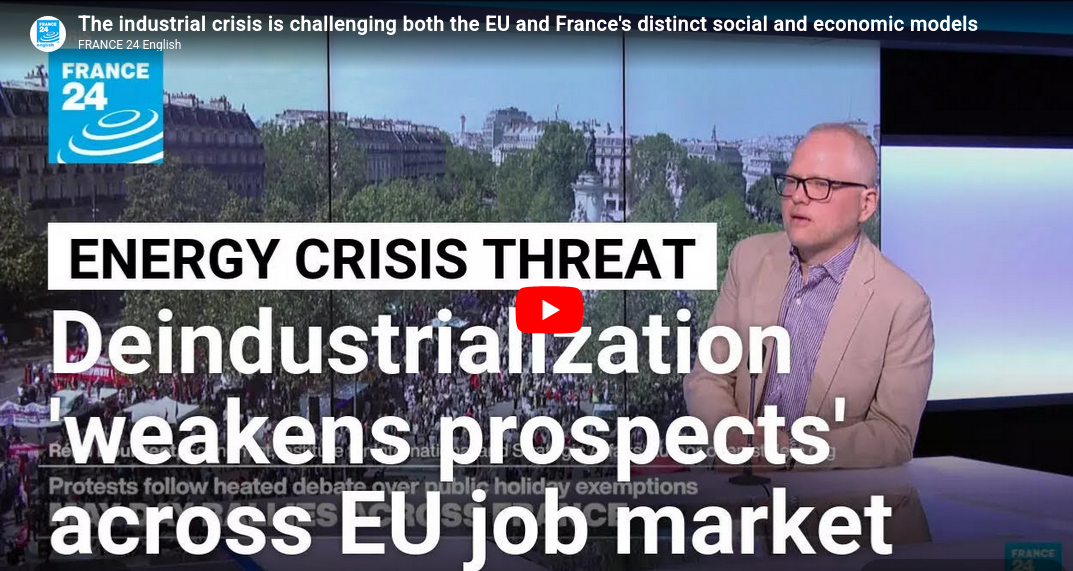
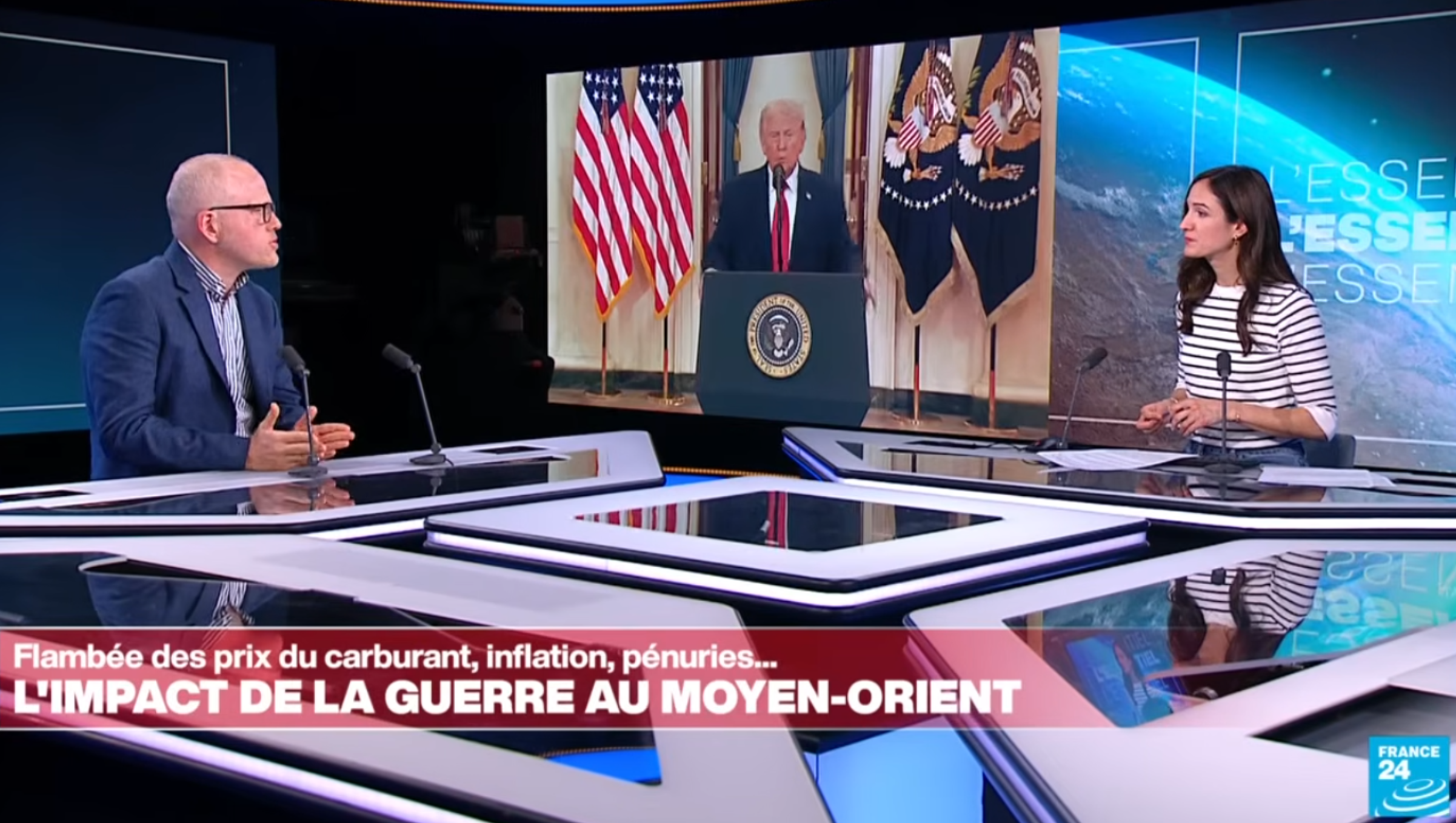
Interview on France 24 in French with journalist and novelist Aude Lechrist and in English with William Hildebrandt on how the Middle East war derails the West’s economic, industrial and social model further. Translation of the French interview below the English video.
Aude Lechrist:In France, as elsewhere in the world, the closure of the Strait of Hormuz is making itself felt. Trade unions are pushing for wage increases, particularly as inflation makes a comeback. To help us understand how workers are being affected by today’s upheavals — the geopolitical situation, climate pressures, and the dizzying pace of advances in artificial intelligence — we are joined by Rémi Bourgeot. Thank you for being here.First, are workers facing the same pressures the world over?
Rémi Bourgeot: Extreme globalization has taken hold, creating significant transmission belts running through industrial models — but alongside that, vastly different policies have been pursued on either side of the divide. The fast-developing countries of Asia have pushed industrial policies, import substitution strategies, and drives toward productive self-sufficiency. The West, by contrast, has undergone rapid deindustrialization over the past few decades.
And yet Asia is heavily affected today on the energy front, even though China in particular had put anticipatory policies in place. This crisis feeds directly through to workers, to job opportunities, and to cost pressures stemming from globalized supply chains — though that globalization is now somewhat in retreat, as countries seek greater autonomy and resilience.
So workers are immediately more exposed — that much is clear from the geopolitical context. What knock-on effects are you observing?
The economic consequences are immediate and concrete — the energy crisis, for instance, has brought production lines to a standstill. Economists point to fractions of a percentage point being shaved off overall GDP, but the real issue is a crisis of the real economy, the physical economy, of supply chains. For many countries around the world, that is precisely what drives economic and industrial development.
And just about everywhere, questions of industrial development, genuine development, educational development are back at the centre of the debate — because these are the factors that determine long-term growth prospects and the opportunities open to workers.
A major fault line has opened up between countries that believed growth could rest indefinitely on services — particularly financial services — and others that have followed a more traditional development path, reminiscent of postwar Europe: industrial development, educational development — which opens up more opportunities for workers, even if working conditions are sometimes very tough.
But right now, an inflection point has clearly been reached: developed countries no longer have a functioning growth model.
Artificial intelligence, which you mentioned at the outset, is also reshuffling the deck — particularly through its applications in robotics, which will increasingly affect manual workers, in addition to office jobs. And again, that fault line is visible, with the development model unraveling across much of the Western world.
The United States has managed to stay ahead on the digital front and now in AI. How do you read that, especially against the backdrop of the Strait of Hormuz crisis — given that the key investors are the Gulf states?
The development model has genuinely unraveled right across the Western world. The United States holds the high ground technologically, but on the premise that it can keep pushing indefinitely down a path heavily dependent on financial flows and foreign capital — particularly from the Gulf.
The announcements from Sam Altman and OpenAI have been staggering — trillions supposedly raised in the Gulf to fund data center infrastructure in the United States and beyond. And the financial structures taking shape among players in this sector have all the hallmarks of a bubble — customers being financed by their own suppliers like Nvidia, investments completely untethered from economic and industrial reality.
And yet genuine innovations do exist, and there is extraordinary talent out there, even from a purely technological standpoint. AI researchers like Yann LeCun argue that generative AI and LLMs are running into a dead end because of their intrinsic errors — something anyone who uses these tools day to day can see for themselves. Other technologies need to be developed, and that is already happening, particularly for robotic applications in the real world.
But the moment an innovation appears, vast financial edifices get built up around it that have little to do with actual economic, industrial, or human development.
And then there is the fear among workers — Americans in particular — who see an economic crisis on the horizon. Trade unions are clearly gearing up for major action. Labor Day in the United States is separate from International Workers’ Day, but significant mobilization is expected today all the same. Donald Trump has clearly done very little to address the concerns of American workers.
Yes, and that is the great paradox. All the wavering, the U-turns, the chaos surrounding Donald Trump tell the story — he was supposed to upend the system in favor of reindustrialization from his very first term. Efforts were made in that direction, but the personal competence simply was not there, nor were the right people around him, to deliver a genuine industrial policy — not even on the tariff front, when it came to applying duties where they were actually needed, where domestic production could realistically be substituted or rebuilt at an acceptable cost.
And yet that question did get put on the table — one that recurs throughout American economic history, as it does in the history of any country pursuing industrial development.
When the Democrats returned to power, they largely continued in the same vein of industrial realism, of attempted reindustrialization — more through subsidies than tariffs, but still within a broadly protectionist logic.
And now, with this new Trump term, the result is a bizarre and catastrophic world of blunt-instrument measures that get walked back almost immediately, with no strategic underpinning and utterly chaotic trade negotiations. The negotiators — on trade, but also on geopolitical, diplomatic, even military matters — have no idea what they are doing. Some of them can barely find the countries in question on a map.
The chaos that has ensued points to a very deep systemic crisis — a crisis of American society and of Western society more broadly — an inability to bring about political renewal, or even basic reform, that would reconcile human and industrial development with the realities of globalization. That can only deepen the anxiety of workers who already see a vast gulf between the uncertainty generated by outside forces — conflicts, tensions, climate risks, artificial intelligence — and their governments’ capacity to respond, compounded by the interdependence between all these countries.
That is genuinely alarming — because beyond all the political divides, the different countries and currents of opinion, there actually is a broad shared diagnosis: reindustrialization is needed. And yet nothing happens. Promises are made and forgotten.
You said as much about the United States, but Europe is no different — if anything it is worse, having missed every significant technology wave over the past twenty or thirty years. The engineering expertise is still there for now, but it is eroding. And has the appetite for innovation gone with it? Is it no longer what drives students who dream of building a better world? Do you share that concern?
What keeps me from losing hope entirely is that talking to young people — students in engineering schools, in other fields, in the humanities — one still finds that curiosity, that intellectual energy. Despite the decline of the education system, a wealth of tools exists online, countless ways of accessing knowledge — with their strengths and their limitations — that still allow people to learn, to catch up, to make discoveries. The curiosity is very much alive.
The problem lies in the economic, political, and industrial system as it stands, which crushes that creativity. Entrepreneurship is a case in point — starting a business is an uphill struggle in Europe and in France especially. And at the level of larger companies and public bodies, reindustrialization is talked about endlessly but always in the vaguest of terms.
Looking back, what has been the real impact of Emmanuel Macron’s two terms on workers in France?
There has been a genuine slippage. A commitment to entrepreneurship was at least proclaimed, but it was mostly rhetorical from the outset. The occasional junior minister had a genuine grounding in the real economy, but overall, a headlong rush toward deindustrialization has unfolded, dressed up in rhetoric pointing in the opposite direction — toward rebuilding France’s industrial fabric. The means simply have not been there: the human resources, the investment decisions at the national level, the European coordination.
Then there is the energy pricing system, which is extremely damaging for the French economy. France should enjoy a competitive advantage thanks to nuclear power, but that advantage is largely neutralized by the European pricing mechanism — a trap the country remains locked in.
On top of that, the strategy of kicking the can down the road goes back to the introduction of the euro. The trade balance has been deteriorating and in the red since the start of the eurozone. This ongoing decline has been masked by the illusion of monetary stability — but with debt soaring and interest rates rising, that cannot go on indefinitely.
What is really lacking is a technological, industrial, economic, and human understanding — including in terms of skills — to get an industrial development agenda back on track. That is exactly what other countries are doing, not that their models should be copied wholesale — China being the obvious example. A genuine boom in industrial development and technological expertise is underway in China today, comparable to Japan’s spectacular catch-up across every technological front forty or fifty years ago.
France has extremely strong expertise — pockets of world-class engineers, outstanding skills, including in mathematics — and none of it is being properly put to use.
Rémi Bourgeot, thank you very much for joining us — a fascinating conversation. Thank you.
Click on the image to view the video on LinkedIn – Full transcript below the summary on this page
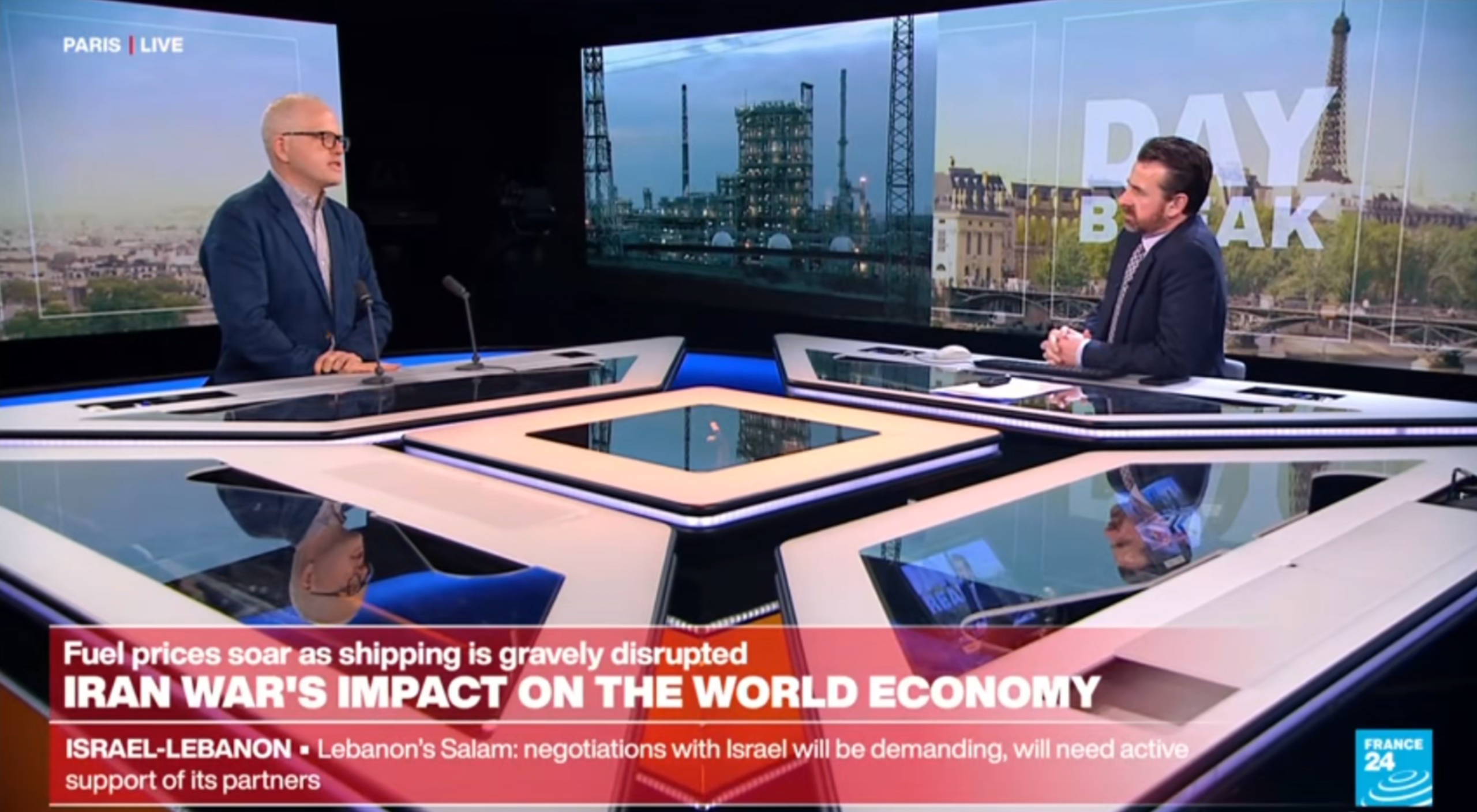
On France 24, I discussed the deep industrial impact of the Iran war and the shift in political bargaining: – Economic forecasts tend to account poorly for shocks in the physical world, focusing on market price variations and assuming substitution. The main economic damage lies in material shortages and supply chain disruptions, from energy to fertilizers to helium for chips manufacturing… – Geopolitically, Trump’s grand bargain on uranium enrichment has stalled. With a peace deal a distant prospect, sanctions relief for Iran is off the table as well. More focused steps should now center on the strait: the level of Iranian control, the lifting of the US blockade, and some international coordination.
Full transcript of the interview:
Good morning, Rémi, and thank you very much for being with us. Can I start by asking you what the immediate effects of the Iran war have been economically, beyond the fuel crunch, which of course everyone is very familiar with?
This situation in energy markets isn’t just a story about rising oil and gas prices—it’s really disrupting supply chains all over the world in critical aspects. It’s about energy imports for many countries, especially in Asia, and also in Europe, but to a lesser extent. But it’s affecting some industries very, very heavily through price surges and shortages.
There was little awareness in the beginning that critical components like helium would disrupt supply chains in production, such as semiconductors and chips generally. So it’s really a global crisis sparked by these shortages and by the way production is being disrupted.
It’s not just about economic statistics or making assumptions about how GDP might be affected over a three-month horizon. It’s a much deeper crisis, really affecting supply chains. And that goes beyond the scope of just short-term economic monitoring and forecasting. It’s a real industrial crisis with so many ramifications—also for food production, in terms of fertilizer imports for so many countries.
The Gulf has become so critical, not just beyond energy. Energy is obviously key, but we see all these ramifications, and this is affecting countries and industries across the world in very different ways. For some countries and social groups, this is having really dramatic effects—it can create situations of famine. You can go to such extreme levels.
You mentioned helium there. Qatar exports 40% of the world’s supply, and it’s used in the production of semiconductors and pretty much across tech in general and other sectors.What might the societal repercussions of shortages in this sense mean for the world?
It was somehow reminiscent of what happened during the COVID pandemic. Supply chains were heavily disrupted, and then there was also a boom in demand with fiscal support. So this is really running very deep into supply chains. You see disruptions everywhere.
Some countries have stocks, so the effect is not immediate. It’s just like in energy markets—some countries have had this policy, this strategy of storing a lot of oil. That’s the case with China, which is supposed to be very dependent on the Gulf but is less affected in the short term thanks to this storage policy. So it applies to many countries and industries. But over time, after a few weeks and especially after a few months, you start to see much more concrete effects with these shortages.
It means it’s really affecting production. It’s not just the rise in prices. There’s really a gap in production at the moment. This directly translates into decreased production. It’s not just about price signals or higher costs—it’s really outside the scope of usual everyday economic reasoning. It’s a crisis affecting the material world, not just economic models.
Now, how critical is this for a lasting peace to be reached in this war? We’ve got an extension, an indefinite extension of the ceasefire, but that does not mean the war is over. Is there a big difference between the war continuing for another three to four weeks or the war continuing beyond that? Or is there already sufficient damage that will be felt for months to come?
Well, it’s a critical distinction indeed. The prospect of a lasting peace or a lasting peace agreement, in my view, is still very distant. There’s been so much confusion in the negotiations—or in the talks, I should say—between Iran and the US, with this focus on the American part on the nuclear issue, even attributing statements to the Iranians which were completely unthinkable in their view. So negotiations have really not taken a good path in that respect.
In the end, you have this prolongation of the ceasefire, and it’s indefinite. That’s really what matters in terms of relieving the pressure somehow. I think the talks are going to focus on the Strait of Hormuz and finding some kind of compromise—acknowledging Iran’s control of the Strait with some toll booth model.
China, for example, has been pressuring Iran to take a moderate approach on the issue of fees. But the key focus right now is finding some kind of limited compromise rather than achieving a peace deal. The US doesn’t even have the proper negotiators to achieve any such aim. There’s been so much confusion on the part of the US to impose this kind of counter-blockade of Iranian ports and ships. It’s trying to have leverage on this specific issue of the reopening of the Strait of Hormuz to find some way with Iran.
But the prospect of incorporating all the possible aspects of a deal, including nuclear energy and uranium enrichment, is really very ambitious and a very distant prospect.
Now the UK and France are spearheading talks to open the Strait of Hormuz or to keep it open once the war comes to an end. We’ve often spoken of de-risking with regards to China from the perspective of Western countries, but is this an instance of European countries perhaps de-risking in the face of Washington’s current unpredictability?
Well, I think when it comes to managing the Strait of Hormuz, it’s not so much a strategy towards the US. There will need to be some kind of international arrangement, even if Iran retains control over the Strait and charges fees. That’s why the Iranians were willing to make some arrangements with Oman to have this international dimension to the management of the Strait.
Europe clearly can be part of it. There needs to be some agreement, some arrangement to reopen the Strait, to make traffic happen smoothly, to reassure insurers, and to return to some kind of business as usual. It won’t be like before—it will be a new situation, clearly—but it has to be a predictable one. That’s really the key issue here.
That’s why the Europeans are all playing this part, trying to show this willingness to take part in an international system of cooperation guaranteeing passage—not free passage literally, but to create a kind of new normalcy for passage through the Strait. That’s really what’s essential. It’s not just Iran stopping its threats to ships and the US lifting their counter-blockade. You need to have a real kind of international arrangement for things to resume in some normal way.
I was interviewed by France 24 about the energy crisis and the challenges of reopening the Strait of Hormuz amid the military stalemate.English transcript below the video.
Rémi Bourgeot, you’ve been following this crisis very closely. Is this only the beginning?
It obviously depends on how the military situation evolves. Donald Trump has been sending mixed signals, and markets have been swinging wildly in response.
What we are seeing, in any case, is a military quagmire. Some geopolitical experts believe this is only the beginning. There are also signs of panic on the part of the U.S. administration, particularly from Donald Trump, who actually dislikes war. In fact, he prefers theatrical operations, like the one in Venezuela a few weeks ago. This, however, is a genuine quagmire.
So he is sending signals suggesting he would like to stop, while striking as hard as possible. The Iranians, for their part, largely dominate the situation, but they are also sending signals through these exchanges, notably with Oman, to at least establish some kind of framework that could apply to a partial reopening.
But what we are heading toward is Iranian control over the Strait of Hormuz. It could be reopened in part, even quite broadly, but likely under Iranian control, given that the United States is not capable of reaching its objectives—assuming there ever were tangible ones.
This Iranian control over the Strait of Hormuz, over time, implies a different system, a different economic regime, notably involving tolls, of which we have already seen certain outlines, partially implemented. That does not mean this will be the final configuration, but costs will be raised and this transit system will be put in place in a way that serves Iran’s geopolitical interests.
There have also been behind-the-scenes signals of exchanges between Iran and certain Gulf states—especially Qatar—to avoid strikes. But the situation is extremely tense, particularly with the United Arab Emirates, which has called on the United States to “finish the job,” to escalate, implicitly suggesting the deployment of ground troops. One could imagine Iran penalizing the United Arab Emirates more than other Gulf states.
And in any case, this reopening cannot be achieved by force, only through negotiations?
There is no real negotiation. There may have been emails or very indirect contacts, but there are very serious doubts about the reality of Donald Trump’s statements when it comes to negotiations.
That said, the notion of de-escalation cannot be ruled out. This is not what we are seeing these days, but Trump is extremely uncomfortable with the situation and understands that he needs to withdraw. His political position is collapsing. There are very serious doubts about his personal condition and about the political system surrounding him. He is dismissing generals around him in order to hear what he wants to hear, to avoid bad news.
What we are seeing is a genuine regime crisis developing in the United States, with much deeper roots. There is also an industrial side to this crisis, as the manufacturing base is unable to sustain what would be a long war.
On the question of ground troops, this is perhaps the most revealing signal: there has been no such announcement. There has been no announcement either of an end to the war or of a withdrawal. Yet sending ground troops would mark the entry into a long war, with even more severe uncertainties—something that would be almost suicidal on Donald Trump’s part.
Today, we are in an in-between situation, with a desire to get out of this quagmire, but Trump wants to be able to claim some form of victory and avoid humiliation. That humiliation is there in any case.
To return to the very concrete consequences of this political and military deadlock, there has been much discussion in recent weeks about measures taken by countries to ration fuel, cut taxes, and provide subsidies. France, for the time being, is refusing to do any of this. Is that relevant?
When it comes to acting on prices, taxes are often short-term measures. They can have positive effects. But the real situation we are facing is a form of shortage that is now emerging. This is about very concrete, material realities: ships that were supposed to arrive are not arriving. A shortage is taking hold, already very severe in Asia.
It is worth recalling that Europe is much less dependent on the Gulf for its energy supply than many Asian countries. The various sources of supply—Norway, North Africa, the United States for LNG, and partly the Gulf—show that this dependence exists but remains limited. Some countries have larger reserves; this is the case for China, which also has greater autonomy, while still being largely dependent on the Gulf.
The reality is therefore material: a shortage is taking shape. It is less pronounced in Europe, but it is already being felt. This is happening in the context of an economic crisis, particularly an industrial one, that was already acute before the start of this war. The issue of energy prices was already critical, with the effects of the war in Ukraine: loss of supply, attempts to reorient away from Russia, but at the cost of creating new dependencies—on the United States or on certain Gulf countries.
We are thus seeing a form of hyper-globalization of energy networks that is now proving extremely vulnerable.
On top of the crisis you’re describing, there is also inflation—the general rise in prices, including food prices to come. Should people in France prepare for this?
Yes, it has a strong inflationary effect. We are not in the same situation as with the war in Ukraine, which came after the pandemic and very expansionary fiscal policies. We are not seeing the same kind of surge, but inflation is clearly rising.
Above all, inflation is a composite index: behind it lies everyday life, constrained spending that affects certain activities and certain social groups more than others. That is what is particularly problematic, both socially and in terms of political instability.
Donald Trump is looking for an off-ramp from the Iran war quagmire. While threatening major escalation that would make parts of the region uninhabitable, he claims that negotiations are taking place.Although real peace negotiations are now out of reach, given the unbridgeable gap in demands, a deescalation is possible.
Countries dependent on energy imports from the Gulf however brace for long term consequences even if the conflict halts. Production capacity is now damaged and Iran is likely to retain a high level of control over the strait.
Europe is less exposed to the supply crisis than Asia but the energy price surge severely aggravates its multiple crises, from manufacturing to debt management. The relegation of nuclear energy leaves the continent particularly exposed to this succession of geopolitical crises, with governments constantly shifting from one external dependency to the next as shocks erupt.
I took part in Al Jazeera’s Counting the Cost. Extracts of my interventions are available here.
Click on the image to listen to the recording on LinkedIn, in French
Full transcript of my interview with France Info public radio on 18 January 2026.
France Info: Hello, Rémi Bourgeot, thank you for joining us on France Info. In just 24 hours, do you think we have crossed all the thresholds that lead to a trade war, an economic war with the United States?
Yes, in fact, we’ve been in this situation for quite some time. You’ll recall that last year, headlines were dominated by Donald Trump’s threats—threats of escalating tariffs—which ultimately led to a so-called “agreement” that was really just a series of demands accepted by the European Commission, including blanket tariffs of 15%, and, on top of that, Europe’s acceptance of very strict constraints, particularly to avoid over-regulating or challenging Californian tech giants. So that’s where we’re coming from. Things had quieted down a bit in recent months.
So, yes, the end of this agreement was extremely unfavorable to the European Union, not only because of the tariffs but also because of the constraints that came with it, and Europe simply accepted the American demands?
Absolutely. This agreement was extremely unfavorable to the European Union, not just because of the tariffs but also because of the constraints that accompanied them. Europe simply accepted the American demands. There wasn’t really any negotiation on the part of Ursula von der Leyen, who was later criticized by several European countries. We thought that was the end of it, but in reality, we’re seeing a much broader deterioration in relations between Europe and the United States—a genuine explosion within the Western bloc.
This is particularly tied to the issue of Ukraine. We can see that the trade measures are targeting countries within the so-called “coalition of the willing.” So this is a much broader escalation. It seems that Trump actually wants to blow up NATO. This is a very aggressive show of force, which today goes far beyond trade—now a secondary issue. We’re in a frankly absurd situation with this Greenland issue. If there were a genuine strategic interest—and perhaps there is for the United States—they could achieve the same benefits through cooperation with Denmark, a country that is extremely close to the United States. Here, we’re seeing broader patterns in Donald Trump’s approach. It’s a much deeper, more long-term deterioration.
The fracturing of the Western block—isn’t that exactly what Donald Trump wants? How can we respond?By activating the anti-coercion mechanism, for one. Emmanuel Macron and his team have indicated that he will call for this instrument to be activated among his European partners. Concretely, Rémi Bourgeot, this is being called an economic “bazooka.” What would it actually look like if this mechanism were triggered?
Well, first of all, we should have threatened and entered into this showdown with Donald Trump from the very beginning, during the negotiations this summer, to avoid being crushed. We needed to understand that this was just the beginning. Today, we’re facing a much broader and more serious aggravation, so we can’t just defend ourselves on the trade front. We have to respond. These measures are part of a fairly broad framework. People talk about a “bazooka,” but it was originally designed to be used against other countries, particularly China. It requires a very large majority in Europe to implement, so it’s not a done deal. But at the very least, we must consider a response. Trump’s counter-response will be escalation, with the threat of economically crushing the Europeans, because his logic is one of humiliation. He has no respect for European leaders, and there are deep disagreements on burning geopolitical issues like Ukraine.
Rémi Bourgeot, you’re describing a catastrophic scenario. How can Europe resist such escalation?
The catastrophic scenario is war, which is unthinkable between Europe and the United States. But what we’re going to see now is escalation. This current escalation, with threats of additional 10% tariffs on the countries involved, was triggered because Europe sent a few soldiers—almost symbolically—to Greenland. On the surface, it’s almost nothing, but Trump tolerates no opposition, even to demands as extraordinary and absurd as acquiring Greenland. The relationship is in a dynamic of fracture. We’re going to see all kinds of escalations. But Trump does tend to back down when faced with firm resistance. China, for example, threatened further escalation and deployed its own “bazooka”—restricting the export of rare earth minerals—which created massive industrial problems for the United States. India, threatened with secondary sanctions to limit its trade with Russia, also reacted strongly. So Trump is sensitive to pushback.
We need to understand this context of deteriorating relations with Europeans over the central issue of Ukraine, which is at the heart of this escalation.
Thank you very much, Rémi Bourgeot, for your analysis as an economist and associate researcher at IRIS. This trade war has existed in reality since Trump’s return, but it seems to be taking a more concrete form in the last 24 hours, with these new tariffs announced by the American president and Europe’s announcement that it intends to retaliate.
A growing divide between those advocating for production, resilience and know-how, and a bureaucracy still mired in the limbo of the 1990s.
The EU is rushing to finalize a trade deal with the Mercosur while simultaneously preparing protective measures against Chinese products that can no longer find a market in the United States.
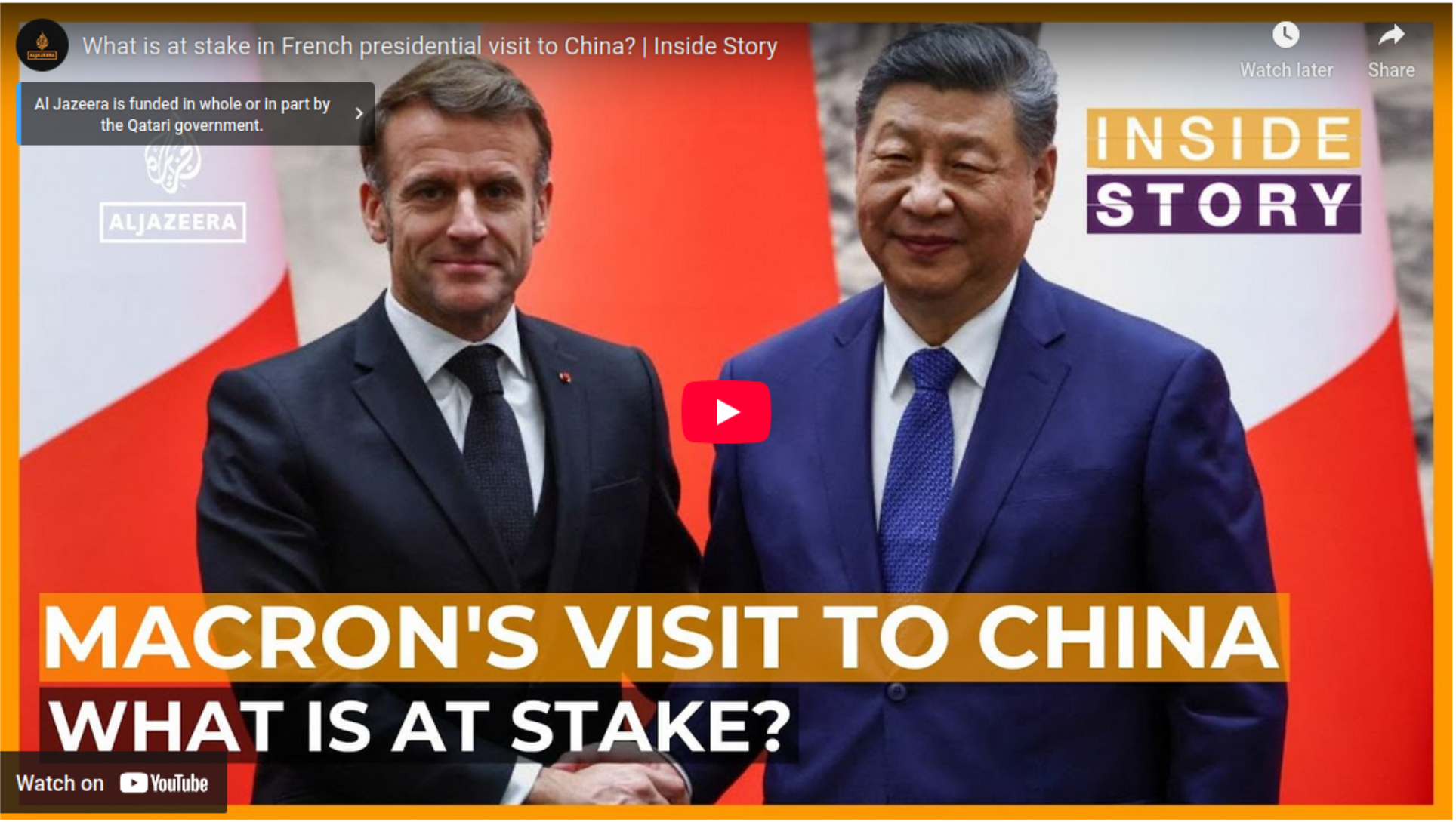
I took part in Al Jazeera’s Inside Story discussion with Andy Mok and Ben Aris. Ailing European economies need to rebalance their trade relations with China and break out of their self-inflicted technological doom loop.
On Donald Trump’s orders, in exchange for unilateral tariffs of ‘just 15%’, the EU suddenly revises its digital regulations to open its market even wider to American Big Tech. But it’s all in the name of competitiveness…
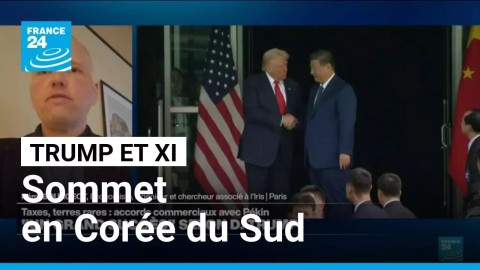
Donald Trump said after a summit in South Korea with his Chinese counterpart Xi Jinping that he had agreed to reduce tariffs on Chinese products to 47% in exchange for Beijing guaranteeing a supply of rare earths and buying American soybeans