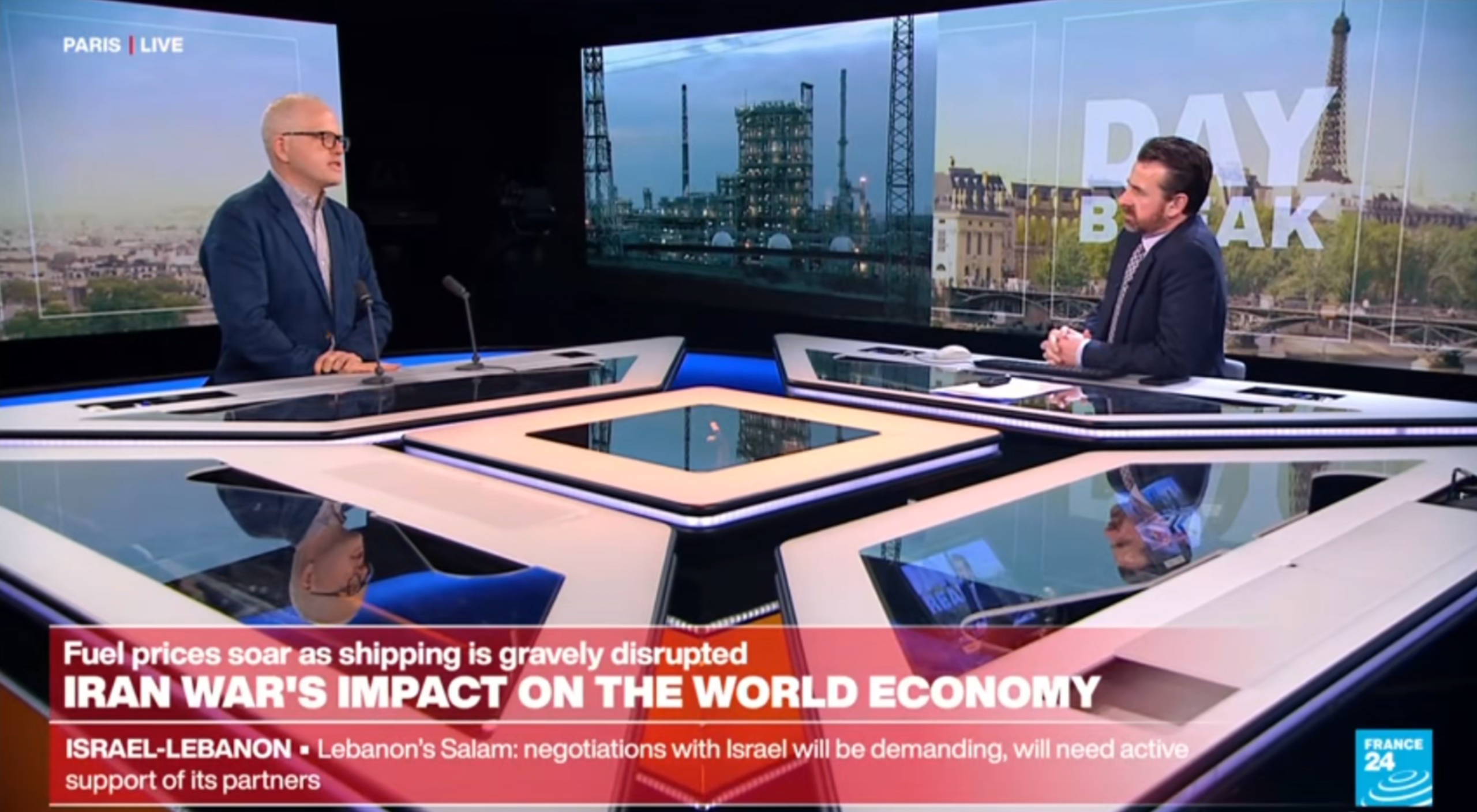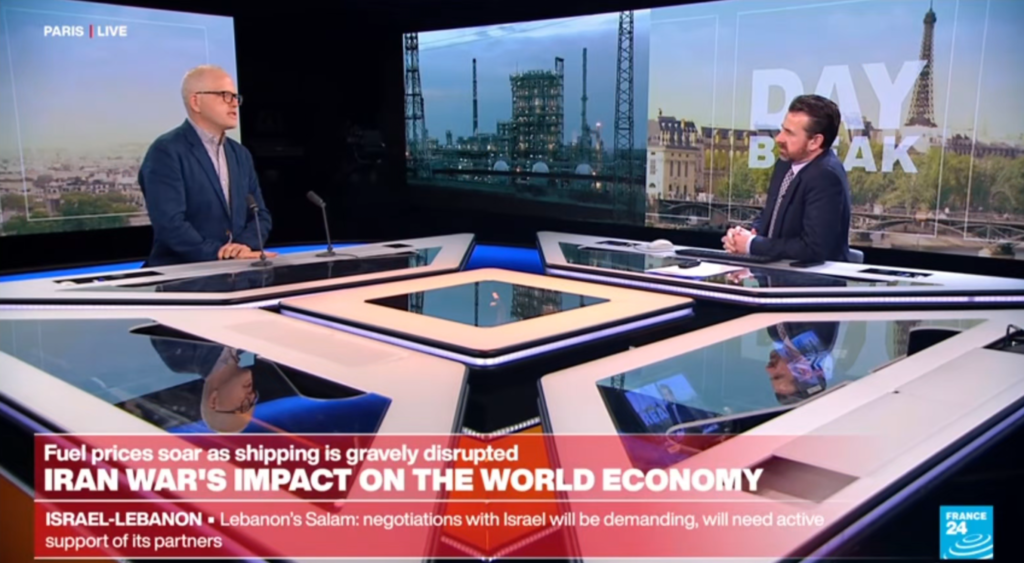


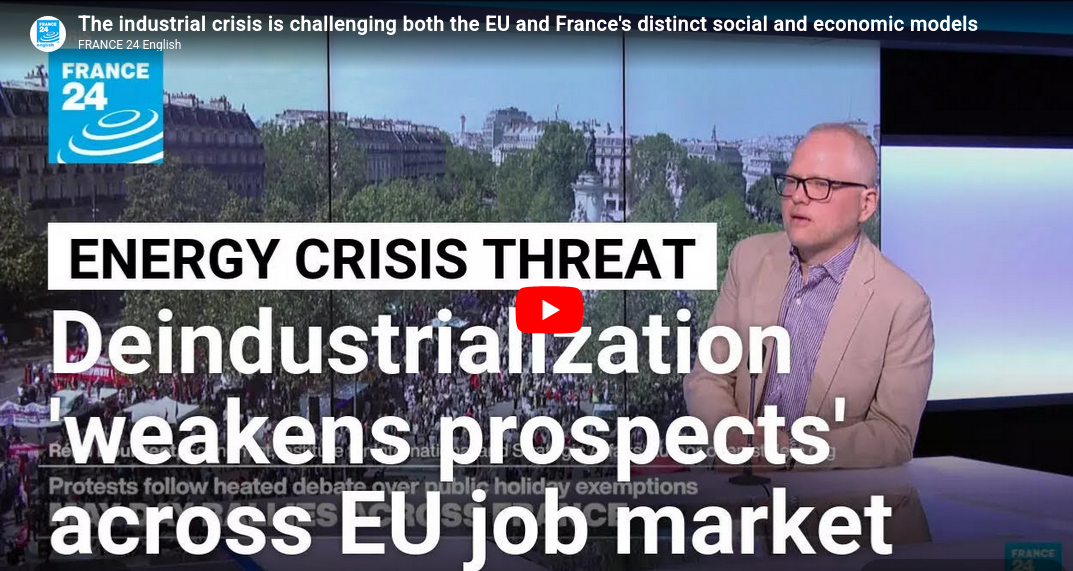
Interview on France 24 in French with journalist and novelist Aude Lechrist and in English with William Hildebrandt on how the Middle East war derails the West’s economic, industrial and social model further. Translation of the French interview below the English video.
Aude Lechrist: In France, as elsewhere in the world, the closure of the Strait of Hormuz is making itself felt. Trade unions are pushing for wage increases, particularly as inflation makes a comeback. To help us understand how workers are being affected by today’s upheavals — the geopolitical situation, climate pressures, and the dizzying pace of advances in artificial intelligence — we are joined by Rémi Bourgeot. Thank you for being here. First, are workers facing the same pressures the world over?
Rémi Bourgeot: Extreme globalization has taken hold, creating significant transmission belts running through industrial models — but alongside that, vastly different policies have been pursued on either side of the divide. The fast-developing countries of Asia have pushed industrial policies, import substitution strategies, and drives toward productive self-sufficiency. The West, by contrast, has undergone rapid deindustrialization over the past few decades.
And yet Asia is heavily affected today on the energy front, even though China in particular had put anticipatory policies in place. This crisis feeds directly through to workers, to job opportunities, and to cost pressures stemming from globalized supply chains — though that globalization is now somewhat in retreat, as countries seek greater autonomy and resilience.
So workers are immediately more exposed — that much is clear from the geopolitical context. What knock-on effects are you observing?
The economic consequences are immediate and concrete — the energy crisis, for instance, has brought production lines to a standstill. Economists point to fractions of a percentage point being shaved off overall GDP, but the real issue is a crisis of the real economy, the physical economy, of supply chains. For many countries around the world, that is precisely what drives economic and industrial development.
And just about everywhere, questions of industrial development, genuine development, educational development are back at the centre of the debate — because these are the factors that determine long-term growth prospects and the opportunities open to workers.
A major fault line has opened up between countries that believed growth could rest indefinitely on services — particularly financial services — and others that have followed a more traditional development path, reminiscent of postwar Europe: industrial development, educational development — which opens up more opportunities for workers, even if working conditions are sometimes very tough.
But right now, an inflection point has clearly been reached: developed countries no longer have a functioning growth model.
Artificial intelligence, which you mentioned at the outset, is also reshuffling the deck — particularly through its applications in robotics, which will increasingly affect manual workers, in addition to office jobs. And again, that fault line is visible, with the development model unraveling across much of the Western world.
The United States has managed to stay ahead on the digital front and now in AI. How do you read that, especially against the backdrop of the Strait of Hormuz crisis — given that the key investors are the Gulf states?
The development model has genuinely unraveled right across the Western world. The United States holds the high ground technologically, but on the premise that it can keep pushing indefinitely down a path heavily dependent on financial flows and foreign capital — particularly from the Gulf.
The announcements from Sam Altman and OpenAI have been staggering — trillions supposedly raised in the Gulf to fund data center infrastructure in the United States and beyond. And the financial structures taking shape among players in this sector have all the hallmarks of a bubble — customers being financed by their own suppliers like Nvidia, investments completely untethered from economic and industrial reality.
And yet genuine innovations do exist, and there is extraordinary talent out there, even from a purely technological standpoint. AI researchers like Yann LeCun argue that generative AI and LLMs are running into a dead end because of their intrinsic errors — something anyone who uses these tools day to day can see for themselves. Other technologies need to be developed, and that is already happening, particularly for robotic applications in the real world.
But the moment an innovation appears, vast financial edifices get built up around it that have little to do with actual economic, industrial, or human development.
And then there is the fear among workers — Americans in particular — who see an economic crisis on the horizon. Trade unions are clearly gearing up for major action. Labor Day in the United States is separate from International Workers’ Day, but significant mobilization is expected today all the same. Donald Trump has clearly done very little to address the concerns of American workers.
Yes, and that is the great paradox. All the wavering, the U-turns, the chaos surrounding Donald Trump tell the story — he was supposed to upend the system in favor of reindustrialization from his very first term. Efforts were made in that direction, but the personal competence simply was not there, nor were the right people around him, to deliver a genuine industrial policy — not even on the tariff front, when it came to applying duties where they were actually needed, where domestic production could realistically be substituted or rebuilt at an acceptable cost.
And yet that question did get put on the table — one that recurs throughout American economic history, as it does in the history of any country pursuing industrial development.
When the Democrats returned to power, they largely continued in the same vein of industrial realism, of attempted reindustrialization — more through subsidies than tariffs, but still within a broadly protectionist logic.
And now, with this new Trump term, the result is a bizarre and catastrophic world of blunt-instrument measures that get walked back almost immediately, with no strategic underpinning and utterly chaotic trade negotiations. The negotiators — on trade, but also on geopolitical, diplomatic, even military matters — have no idea what they are doing. Some of them can barely find the countries in question on a map.
The chaos that has ensued points to a very deep systemic crisis — a crisis of American society and of Western society more broadly — an inability to bring about political renewal, or even basic reform, that would reconcile human and industrial development with the realities of globalization. That can only deepen the anxiety of workers who already see a vast gulf between the uncertainty generated by outside forces — conflicts, tensions, climate risks, artificial intelligence — and their governments’ capacity to respond, compounded by the interdependence between all these countries.
That is genuinely alarming — because beyond all the political divides, the different countries and currents of opinion, there actually is a broad shared diagnosis: reindustrialization is needed. And yet nothing happens. Promises are made and forgotten.
You said as much about the United States, but Europe is no different — if anything it is worse, having missed every significant technology wave over the past twenty or thirty years. The engineering expertise is still there for now, but it is eroding. And has the appetite for innovation gone with it? Is it no longer what drives students who dream of building a better world? Do you share that concern?
What keeps me from losing hope entirely is that talking to young people — students in engineering schools, in other fields, in the humanities — one still finds that curiosity, that intellectual energy. Despite the decline of the education system, a wealth of tools exists online, countless ways of accessing knowledge — with their strengths and their limitations — that still allow people to learn, to catch up, to make discoveries. The curiosity is very much alive.
The problem lies in the economic, political, and industrial system as it stands, which crushes that creativity. Entrepreneurship is a case in point — starting a business is an uphill struggle in Europe and in France especially. And at the level of larger companies and public bodies, reindustrialization is talked about endlessly but always in the vaguest of terms.
Looking back, what has been the real impact of Emmanuel Macron’s two terms on workers in France?
There has been a genuine slippage. A commitment to entrepreneurship was at least proclaimed, but it was mostly rhetorical from the outset. The occasional junior minister had a genuine grounding in the real economy, but overall, a headlong rush toward deindustrialization has unfolded, dressed up in rhetoric pointing in the opposite direction — toward rebuilding France’s industrial fabric. The means simply have not been there: the human resources, the investment decisions at the national level, the European coordination.
Then there is the energy pricing system, which is extremely damaging for the French economy. France should enjoy a competitive advantage thanks to nuclear power, but that advantage is largely neutralized by the European pricing mechanism — a trap the country remains locked in.
On top of that, the strategy of kicking the can down the road goes back to the introduction of the euro. The trade balance has been deteriorating and in the red since the start of the eurozone. This ongoing decline has been masked by the illusion of monetary stability — but with debt soaring and interest rates rising, that cannot go on indefinitely.
What is really lacking is a technological, industrial, economic, and human understanding — including in terms of skills — to get an industrial development agenda back on track. That is exactly what other countries are doing, not that their models should be copied wholesale — China being the obvious example. A genuine boom in industrial development and technological expertise is underway in China today, comparable to Japan’s spectacular catch-up across every technological front forty or fifty years ago.
France has extremely strong expertise — pockets of world-class engineers, outstanding skills, including in mathematics — and none of it is being properly put to use.
Rémi Bourgeot, thank you very much for joining us — a fascinating conversation. Thank you.